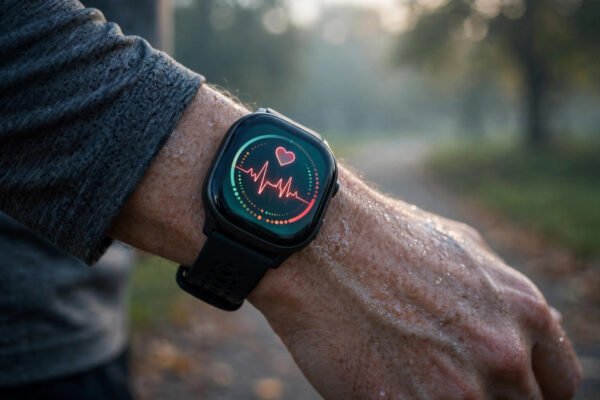
Your running watch now tracks more physiological data than the sports science lab of a 1990s Olympic team. Heart-rate variability, blood-oxygen saturation, running power, ground-contact time, sleep architecture, training load, recovery estimates — a $300 wearable generates a daily briefing that would have required a team of PhDs thirty years ago.
This is the quiet revolution in amateur athletics: sports science, once locked inside elite institutions, has been fully democratized. Weekend warriors now train with the same metrics as pros. The question is no longer whether amateurs can access the data — it’s whether they know what to do with it.
How the Lab Escaped Into the Wild
The democratization happened in three waves. First, GPS watches in the 2000s gave runners pace and distance — basic, but revolutionary. Second, optical heart-rate sensors in the 2010s added the cardiovascular layer, letting anyone train by zones. Third — the current wave — brought the recovery metrics: HRV, sleep staging, SpO2, and algorithmic readiness scores that synthesize it all into a single daily number.
Each wave followed the same pattern: pro-team technology, miniaturized and cheapened, sold to consumers with an app. What cost an elite program tens of thousands in lab equipment now ships in a watch. The NIH’s ongoing sports-medicine research continues to validate (and occasionally puncture) the claims these devices make, but the direction is one-way: more sensors, more metrics, lower prices.
What Weekend Warriors Actually Track
The metrics that matter
Ask experienced amateur athletes which numbers they actually use and a consistent hierarchy emerges. Sleep duration and quality rank first — the metric with the strongest evidence and the clearest action (go to bed). Resting heart rate and HRV trends come second, as early-warning systems for illness and overtraining. Training load (the rolling balance of workout stress versus recovery) is third — the number that tells you whether you’re building fitness or digging a hole.
Everything else — VO2 max estimates, race predictors, “body battery” scores — is entertainment with occasional insight. Useful, fun, but not the foundation.
The metrics that mislead
The danger metrics are the single-day scores. A “readiness” number that says 42 can talk a healthy athlete out of a workout they’d have benefited from; a watch-estimated VO2 max can convince a runner they’re fitter (or less fit) than reality. The pros treat data as trends over weeks; amateurs too often treat it as a daily verdict. The device manufacturers, incentivized toward engagement, design for the daily check-in — which is precisely the wrong granularity for training decisions.
Strava and the Social Data Layer
No account of amateur analytics is complete without Strava, which turned training data into social currency. Segments, kudos, relative-effort scores, and the infamous “suffer score” gamified the workout log. For millions, the data isn’t just for training — it’s the training’s social proof.
This social layer changed behavior in measurable ways: runners run more consistently when their data is public, group challenges drive volume, and segment hunting has literally reshaped where people train. It’s also created new pathologies — the pressure to make every run “kudos-worthy,” the anxiety of a week without uploads. The data made amateurs more consistent and more neurotic in equal measure.
Newcomers to the whole ecosystem should start with the basics before buying the fancy watch — starting running from scratch requires shoes and consistency, not sensors.
The AI Coach Arrives
The newest wave is algorithmic coaching: apps that ingest your wearable data and generate adaptive training plans. Platforms like these promise what a human coach provides — periodization, workout prescription, adjustment for life stress — at a fraction of the cost. For the vast middle of amateur athletes who can’t afford (or don’t want) a human coach, it’s a genuine breakthrough.
Early evidence suggests AI coaching works well for the standard cases: building base fitness, training for a first marathon, returning from a layoff. It struggles where human coaches excel — the weird cases, the injury histories, the athlete whose data says “go” but whose body says “no.” The best implementations pair algorithmic plans with human oversight, but the economics point toward pure AI for the mass market.
The Pitfalls: Data Anxiety and Overtraining by Numbers
Sports psychologists have a name for the dark side: data-driven anxiety. Athletes who once ran by feel now can’t enjoy an “easy” run if their watch says their heart rate is five beats too high. Rest days feel like failures when the app shows declining “fitness” scores. The quantified self becomes the anxious self.
There’s also a subtler trap: optimizing the measurable at the expense of the important. No wearable tracks joy, and the athletes who burn out are often the ones whose numbers looked perfect. Coaches increasingly prescribe “naked” workouts — no watch, no data — as mental-health maintenance. Even the ideal time of day to exercise matters less than simply enjoying the session enough to repeat it tomorrow.
What the Pros Do Differently
Here’s the irony: professional athletes, awash in more data than any amateur, are often less reactive to daily numbers. Pro teams employ sports scientists precisely to prevent athletes from over-interpreting noise. The data informs the program; the coach makes the call; the athlete’s subjective feeling still counts. The amateur with a watch has the pro’s data but not the pro’s interpreter — which is why the most valuable skill in the wearable era isn’t collecting data, it’s knowing when to ignore it.
Data analytics reached the weekend warrior because the technology got cheap, the apps got smart, and the culture got curious. The revolution is real: amateurs train smarter, recover better, and understand their bodies more deeply than any previous generation. The next revolution will be wisdom — learning that the numbers are a tool, not a verdict, and that the best metric was never on the watch at all. It’s whether you still love doing it.
The democratization also keeps accelerating. Every sensor generation adds capability — continuous glucose monitors for endurance athletes, sweat-analysis patches, smarter sleep staging — while prices keep falling. The gap between what a pro team knows and what a weekend warrior knows has never been smaller. What remains is the human part: the judgment to use the data well, the discipline to rest when the numbers say rest, and the wisdom to sometimes leave the watch at home.
For a measured take on what wearables can and cannot tell you, the Cleveland Clinic’s health library reviews the evidence on fitness trackers and health outcomes.
Frequently Asked Questions
Do I need a fancy sports watch to train effectively?
No. Consistency, progressive overload, and adequate recovery drive 90% of results. A basic GPS watch or even a phone app covers the essentials; advanced metrics are optimization tools for committed athletes, not prerequisites.
What is HRV and should I track it?
Heart-rate variability measures variation in time between heartbeats — higher generally indicates better recovery and autonomic balance. Tracking the multi-week trend can flag overtraining or illness, but daily fluctuations are mostly noise.
Can AI coaching replace a human coach?
For standard training goals, AI coaching apps are increasingly effective and far cheaper. Human coaches still win for complex situations: injury history, unusual schedules, race-day tactics, and the motivation that comes from accountability to a real person.
How do I avoid becoming obsessed with my training data?
Check trends weekly rather than scores daily, schedule regular watch-free workouts, and remember that subjective feel — energy, mood, motivation — is data too. If the numbers are making exercise miserable, the numbers are the problem.