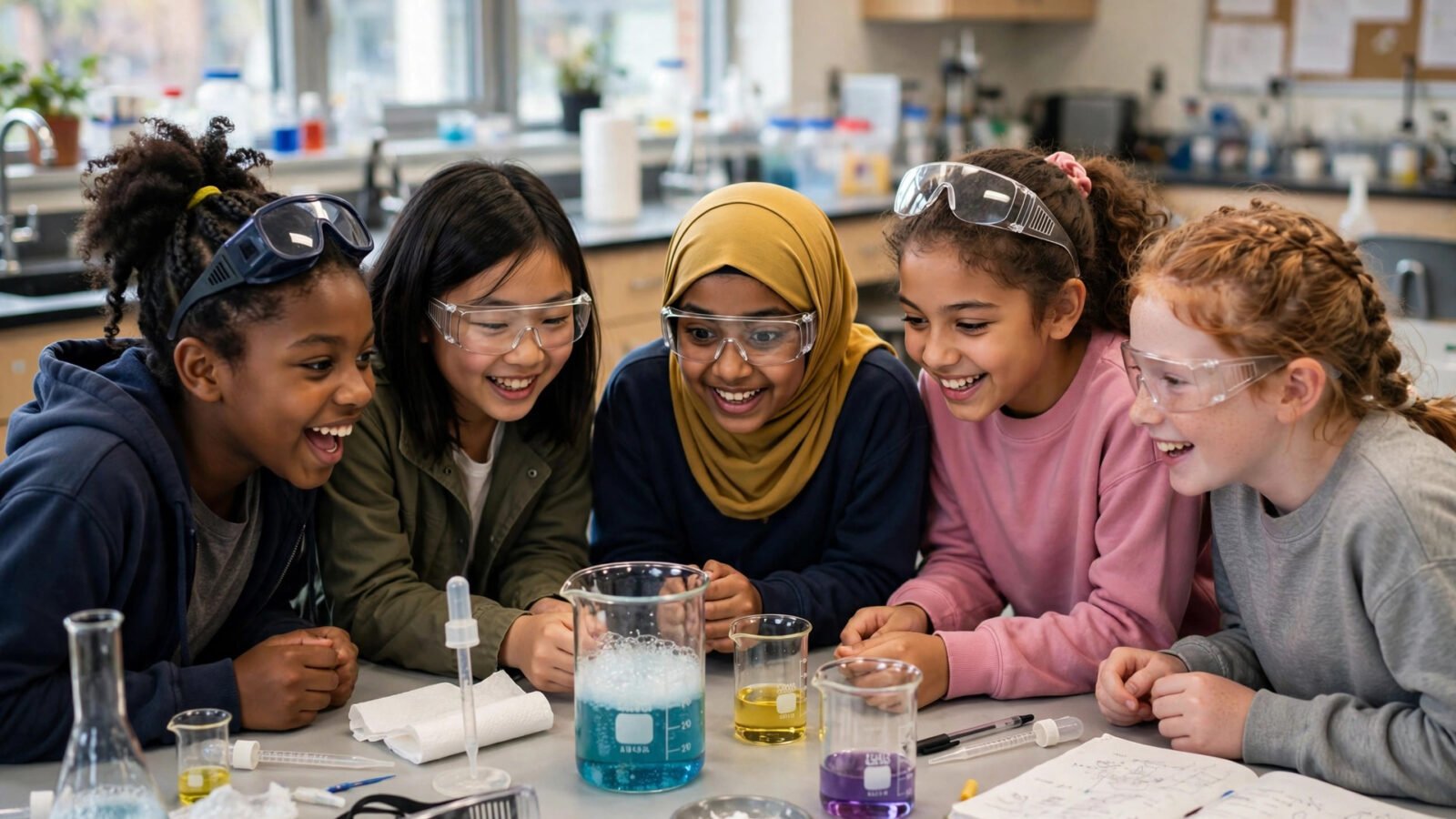
In a robotics lab in Ohio, a team of middle-school girls fine-tunes the autonomous routine that just won them the state championship. In a chemistry classroom in Georgia, high-school girls run titration experiments with the casual confidence of lab techs. In coding clubs across the country, girls now outnumber boys in some of the fastest-growing programs. None of this happened by accident.
STEM programs for girls have grown steadily for over a decade — in enrollment, in funding, in cultural visibility — and the momentum keeps building. The gender gap in science and technology hasn’t closed, but the pipeline feeding it looks radically different than it did twenty years ago. Here’s what’s driving the growth and what’s actually working.
The Pipeline Problem That Started It All
The rationale for girls-in-STEM programs was always the data: women remain underrepresented in engineering, computer science, and physics, despite outperforming boys academically in many STEM subjects through high school. The leak in the pipeline wasn’t ability — it was a thousand small discouragements: stereotypes about who “looks like” an engineer, lack of role models, classroom dynamics that favored the loudest voices, and the well-documented confidence gap that hits girls right around middle school.
Early interventions focused on exposure — the theory being that girls couldn’t aspire to what they’d never seen. Science fairs, robotics demos, “meet a woman engineer” days. Exposure mattered, but the field learned that inspiration without infrastructure fades fast. The programs that endured built sustained engagement: multi-year pathways, not one-off events.
What the Successful Programs Do Differently
Start early, stay long
The most effective programs begin in elementary or middle school and maintain contact for years — summer camps that become after-school clubs that become mentorship networks that become internships. The National Science Foundation’s research on STEM persistence consistently shows that duration of engagement predicts outcomes far better than intensity of any single experience. A girl who codes for four summers is on a different trajectory than one who attended a single workshop.
Build belonging, not just skills
The programs with the best retention treat social belonging as a core deliverable, not a side effect. Girls-only cohorts (controversial but effective for the middle-school years), near-peer mentors just a few years ahead, and communities where being “the STEM kid” is an identity rather than an anomaly. The research on stereotype threat and belonging uncertainty explains why: girls persist in STEM when they feel they belong there, and belonging is built socially.
Connect to purpose
Study after study finds that girls (and many boys) engage more deeply with STEM framed around helping people and solving real problems — biomedical engineering over abstract circuits, environmental science over rote coding drills. The programs growing fastest lead with mission: clean water, disease detection, assistive technology. The Department of Education’s STEM initiatives have increasingly emphasized this purpose-driven framing.
The Role-Model Revolution
Representation has compounded. The generation of women who entered STEM in the 2000s and 2010s are now senior enough to be visible — leading labs, founding companies, keynoting conferences, posting lab life on social media. A girl interested in robotics today can find a hundred women roboticists to follow; twenty years ago she might have found none. Media representation followed: the “hidden figures” narrative went mainstream, and STEM heroines became stock characters in children’s media rather than exceptions.
Social media deserves specific credit. “STEMTok” creators — women engineers and scientists showing their daily work — reach millions of girls who’d never attend a formal program. The algorithm, for once, works in equity’s favor: a girl who watches one chemistry video gets served a hundred more, creating a self-reinforcing interest pipeline that no outreach budget could buy.
The Numbers: Real Progress, Real Gaps
The progress is measurable. Women’s share of STEM bachelor’s degrees has risen substantially; computer science — the field with the most notorious gender gap — has seen women’s enrollment rebound from its early-2000s nadir; girls now participate in high-school AP STEM courses at rates approaching boys in several subjects. Girls Who Code and similar organizations count alumni in the hundreds of thousands.
The gaps that remain are specific and stubborn. Women are still sharply underrepresented in engineering subfields (mechanical, electrical), in physics, and — critically — in the senior ranks: the pipeline leaks most at the transition from education to sustained career, driven by workplace culture, caregiving expectations, and promotion dynamics. Programs for girls fixed the entry; the career-retention problem is a different battle.
The field is also grappling with intersectionality: the programs work least well for the girls who need them most — low-income girls, girls of color, rural girls — because access tracks privilege. The next frontier isn’t more programs for suburban girls; it’s reaching everyone else.
What’s Working Now: The New Playbook
The current generation of programs reflects hard-won lessons. Family engagement: programs that involve parents — especially in communities where STEM careers are unfamiliar — see dramatically better persistence. The message has to reach the whole household, which is why outreach increasingly speaks to parents’ aspirations too, connecting to practical concerns like learning to code as a beginner alongside their daughters.
School integration beats after-school isolation: the programs with the biggest reach embed in the school day rather than competing with sports, jobs, and homework for after-school hours. And career-connected learning — internships, job shadows, industry projects — answers the “but what would I actually do?” question that kills interest in the abstract.
Policy is catching up: states are funding STEM teacher training, requiring computer-science offerings, and tracking participation by gender the way they track test scores. Accountability, as always, drives action.
The AI Wild Card
Artificial intelligence cuts both ways for girls in STEM. On one hand, AI tools lower the barrier to entry — a girl intimidated by syntax can now build with natural-language prompting, and AI tutors provide judgment-free help. On the other, the AI boom risks re-masculinizing tech culture just as it was diversifying, if the new wave of AI founders and researchers skews male again.
The programs responding well treat AI as the new literacy: teaching girls not just to use AI tools but to shape them, question their biases, and lead their development. The debate over degrees and AI misses the deeper point — the question isn’t whether credentials matter, but who gets to build the future. Girls’ STEM programs are making sure the answer includes girls.
STEM programs for girls keep growing because they work — not perfectly, not completely, but measurably and increasingly. The pipeline is fuller, the culture is shifting, and the girls in those robotics labs aren’t waiting for permission anymore. They’re building the future, one autonomous routine at a time. The gender gap in STEM won’t close this year or next. But for the first time, its closing feels like a matter of when, not if.
Frequently Asked Questions
Why are STEM programs for girls important?
Women remain underrepresented in engineering, computer science, and physics despite strong academic performance. Targeted programs address the specific barriers — stereotypes, lack of role models, belonging gaps — that push capable girls out of the pipeline.
What age should girls start STEM programs?
Elementary or middle school is ideal — research shows sustained, multi-year engagement predicts persistence far better than late or one-off interventions. But high-school entry programs also show strong results.
Do girls-only STEM programs work better than coed?
For middle-school ages, girls-only cohorts show better engagement and confidence outcomes in many studies, likely by reducing stereotype threat. By high school and college, well-designed coed programs with strong belonging cultures work equally well.
How can parents support girls interested in STEM?
Encourage tinkering and building early, counter stereotypes explicitly (“engineers look like you”), find sustained programs rather than one-off events, connect daughters with women mentors, and frame STEM around helping people and solving real problems.