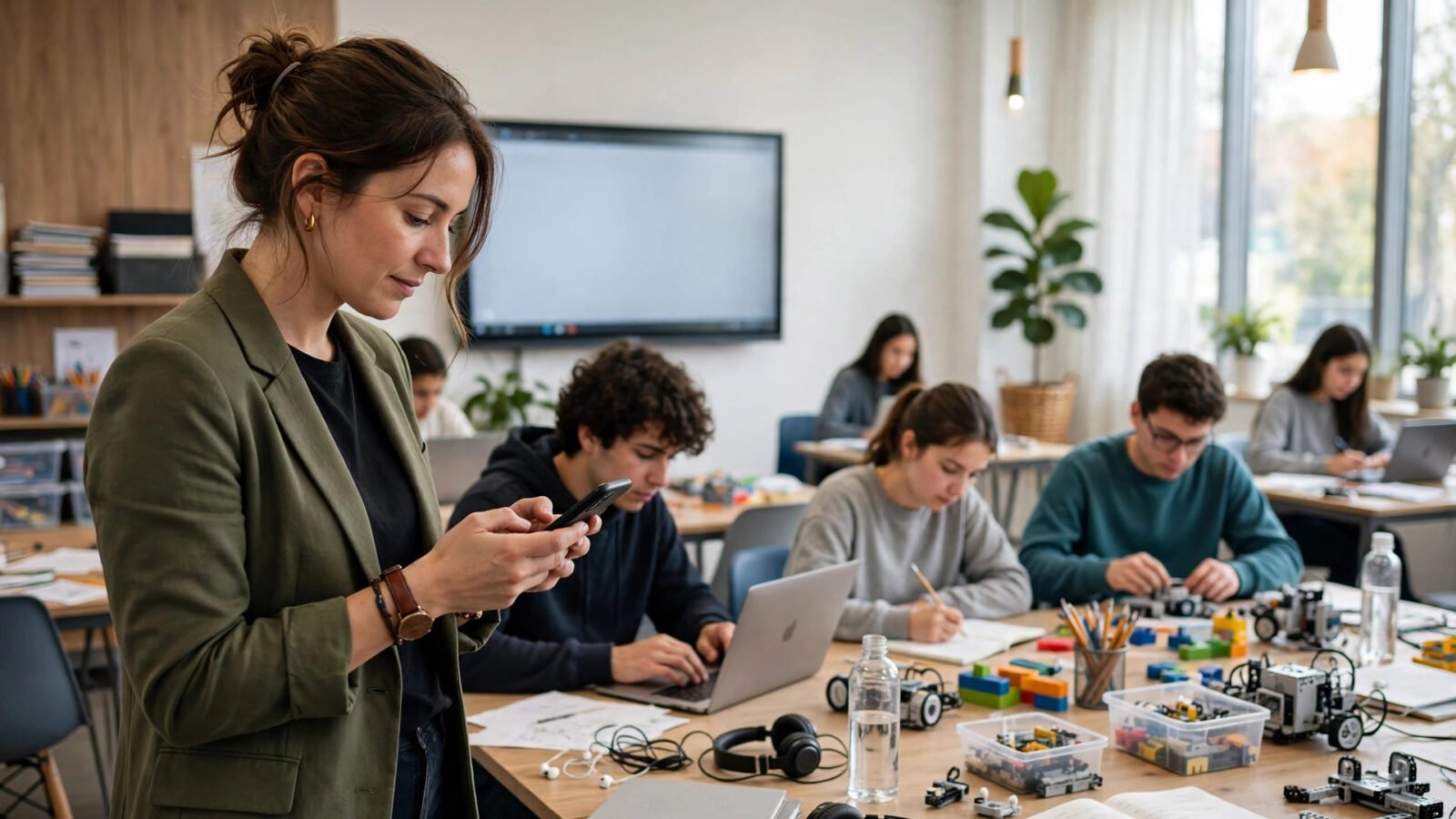
There was a time when parent-teacher communication meant a twice-yearly conference, a report card sent home in a backpack (maybe), and a phone call if something was seriously wrong. The information gap between school and home was enormous — parents found out about problems weeks late, teachers couldn’t reach half their families, and everyone operated on stale news.
That world is gone. Parent-teacher tech platforms — ClassDojo, Remind, Seesaw, ParentSquare, TalkingPoints, and a growing field of competitors — have rewired the school-home relationship into something continuous, instant, and data-rich. The rise of these platforms is one of the most consequential and least examined transformations in modern education.
What the Platforms Actually Do
The category spans several overlapping functions. Messaging platforms (Remind, TalkingPoints) give teachers broadcast and two-way messaging with automatic translation into 100+ languages — solving the communication barrier for immigrant families overnight. Behavior and classroom-culture apps (ClassDojo) let teachers share moment-to-moment updates, photos, and positive reinforcement points. Portfolio platforms (Seesaw) let students document their own learning with photos, videos, and voice recordings that parents can see daily. District-level systems (ParentSquare, Finalsite) unify announcements, sign-ups, payments, and emergency notifications.
Used together, they create something unprecedented: a continuous window into the school day. Parents see the science experiment as it happens, get the field-trip form before it crumples in the backpack, and message the teacher directly instead of playing phone tag through the front office. For engaged parents, it’s a superpower. For teachers, it’s… complicated.
Why They Exploded: The Pandemic Accelerant
Many of these platforms existed before 2020, but the pandemic made them essential infrastructure. Remote schooling required constant school-home communication; when in-person learning resumed, nobody wanted to give up the connectivity. Districts that had resisted the platforms adopted them overnight, and usage never retreated — it deepened.
The demographic logic is powerful too. Millennial and Gen Z parents — digital natives who manage their entire lives by app — expect school communication to work like everything else: instant, mobile, translated, archived. A school that communicates via crumpled paper notices feels broken to them, and they’re right. The Pew Research Center’s data on parental tech expectations shows the generational shift clearly: the parents now filling elementary schools have never known a world without smartphones.
The Translation Revolution (The Underrated Story)
The single most impactful feature may be the least glamorous: automatic translation. TalkingPoints and its competitors translate teacher messages into families’ home languages instantly — and translate replies back. For the millions of American families where parents aren’t fluent in English, this didn’t just improve communication; it created it. Parent engagement among English-learner families — historically the hardest to reach — has measurably improved in districts using translated messaging.
This is an equity story that deserves more attention. The old system effectively excluded non-English-speaking parents from their children’s education. The new system includes them by default. Whatever the platforms’ other issues, this alone justifies their existence — and it’s why parents navigating AI tools increasingly encounter school platforms as their first institutional AI touchpoint.
The Teacher’s Perspective: Connection and Overload
Ask teachers about the platforms and you’ll get a split verdict. The connection gains are real: faster parent contact, fewer misunderstandings, positive news shared routinely instead of only bad news by phone. Teachers report that proactive positive messaging — the “your kid did great today” text — transforms parent relationships, building goodwill reserves that pay off when difficult conversations become necessary.
But the overload is equally real. The platforms created an expectation of near-instant teacher availability — the parent who messages at 9 p.m. and expects a reply, the stream of minor questions that used to wait for conferences, the performative pressure of documenting everything photogenically. Teacher burnout research now lists “communication overload” among the aggravating factors, and districts are belatedly writing policies: no expectation of after-hours replies, office-hours norms for messaging, administrators modeling boundaries.
The dynamic mirrors the broader debate about teachers’ relationship with classroom AI — technology that empowers and exhausts in equal measure, with the balance depending on implementation and boundaries.
Data, Privacy, and the Surveillance Question
The platforms collect sensitive data about children — behavior records, photos, messages, learning portfolios — and the privacy implications are significant. The best providers have strong protections: FERPA compliance, no advertising to students, data-deletion controls. But the sector includes weaker actors, district procurement is inconsistent, and parents rarely read the terms they’re implicitly accepting.
There’s also a subtler concern: the quantification of childhood. Behavior-point systems, constant photo documentation, and permanent digital records change the nature of school — every moment becomes content, every behavior becomes data. Child-development experts warn about the effects of growing up under continuous institutional observation, even benevolent observation. The platforms’ defenders note that the alternative — the old information void — wasn’t obviously better for kids. Both things can be true.
Families should know their rights: what data is collected, how long it’s kept, who can access it, and how to opt out of non-essential features. And the device-management basics still apply at home — parental controls on children’s tablets remain the first line of defense for the youngest users.
What’s Next: AI and the Proactive School
The next wave is AI-mediated communication: platforms that draft teacher messages, summarize long threads, flag concerning patterns (a student’s declining engagement across classes), and auto-translate with near-human quality. The vision is a school that communicates proactively — reaching out before problems crystallize — rather than reactively.
The risk, as always, is the human relationship getting automated away. The platforms work best as amplifiers of teacher judgment, not replacements for it. A well-crafted personal note from a teacher still outperforms any automated nudge — and the schools seeing the best outcomes use technology to create more human contact, not less: more conferences (now easier to schedule), more celebrations, more partnership.
The rise of parent-teacher tech platforms closed one of education’s oldest gaps — the chasm between what happens at school and what families know about it. The window into the classroom is now open, in real time, in every language. The remaining work is wisdom: using that visibility to build genuine partnership rather than surveillance, setting boundaries that protect teachers’ humanity, and remembering that behind every data point is a child. The technology connected the adults. The children are still waiting to see what the adults do with the connection.
On the screen-time and safety side, Common Sense Media’s family resources help parents evaluate the apps schools ask them to install.
Frequently Asked Questions
What are parent-teacher communication platforms?
Apps and systems (ClassDojo, Remind, Seesaw, ParentSquare, TalkingPoints) that enable messaging, updates, portfolios, and announcements between schools and families — with features like automatic translation and photo sharing.
Do these platforms improve student outcomes?
Research links strong parent-teacher communication to better attendance, behavior, and achievement. The platforms’ specific impact is still being studied, but improved engagement — especially among hard-to-reach families — is well documented.
Are my child’s data safe on school apps?
Reputable providers comply with FERPA and restrict data use, but protections vary. Parents should ask schools what data is collected, how long it’s retained, and whether they can opt out of non-essential features.
Should teachers be expected to reply to messages at night?
No — and growing numbers of districts now formalize this with policies setting communication hours and response-time expectations, recognizing that teacher burnout helps no one.