Lighting eats about 15% of the average home’s electricity, and most of that is waste heat from outdated bulbs. I replaced every bulb in my house with LEDs over a few months, and my lighting energy use dropped by roughly 75%. The bulbs paid for themselves in under a year, and I haven’t changed one since.
But ‘buy LEDs’ is only step one. The best energy-efficient light bulbs for every room depend on brightness, color temperature, and fixture type. Here’s the room-by-room guide.
Best Energy-Efficient Light Bulbs for Every Room: The Basics
All modern energy-efficient bulbs are LEDs; compact fluorescents are obsolete. LEDs use about 75% less energy than incandescents and last 15,000-25,000 hours versus 1,000. A $3 LED that lasts a decade beats a $1 incandescent you replace yearly, on both cost and hassle.
Shop by lumens, not watts. Lumens measure brightness: 800 lumens replaces a 60W incandescent, 1,100 replaces 75W, 1,600 replaces 100W. And choose color temperature deliberately: 2700K is warm and cozy (living rooms, bedrooms), 3000K is neutral warm (kitchens, baths), 4000K+ is cool and clinical (garages, task areas). The DOE’s lighting guide has excellent detail on choosing efficiently.
- Buy LEDs only. 75% less energy, 15-25x longer life. CFLs are obsolete; incandescents are money bonfires.
- Shop by lumens. 800 lm = 60W equivalent, 1100 lm = 75W, 1600 lm = 100W. Lumens measure actual brightness.
- Match color temperature. 2700K cozy (living/bedroom), 3000K neutral (kitchen/bath), 4000K+ task (garage/office).
- Check the CRI. Color Rendering Index 80+ for general use, 90+ where color matters (bathroom mirrors, art).
- Look for ENERGY STAR. Certified bulbs meet efficiency and quality standards. Worth the small premium.
- Buy in multi-packs. Per-bulb cost drops significantly. You’ll use them; bulbs are a whole-house project.
Room-by-Room Recommendations
Living rooms and bedrooms want warm 2700K light that’s dimmable for evening relaxation. Use 800-lumen bulbs in table and floor lamps, brighter 1,100+ in ceiling fixtures. Kitchens need brighter, neutral 3000K light: 1,100-1,600 lumens in ceiling fixtures plus under-cabinet LED strips for task lighting on counters.
Bathrooms need high-CRI 3000K bulbs around mirrors for accurate color (makeup, shaving), plus a bright ceiling light. Home offices do best with 4000K in task lamps for alertness, balanced with warmer ambient light. Outdoors, use dusk-to-dawn LED fixtures and motion sensors; the most efficient bulb is one that’s off when unneeded.
- Living/bedroom: 2700K dimmable. Warm and relaxing. 800 lm in lamps, 1100+ in ceiling fixtures.
- Kitchen: 3000K bright. 1100-1600 lm ceiling plus under-cabinet strips. Task lighting matters most here.
- Bathroom: 3000K high-CRI. 90+ CRI around mirrors for true color. Bright ceiling light for general use.
- Home office: 4000K task. Cooler light aids focus at the desk; warmer ambient for the rest of the room.
- Outdoor: dusk-to-dawn + motion. LED fixtures with sensors. The efficient bulb is the one that’s off when unneeded.
- Closets/hallways: basic LEDs. 800 lm, 3000K. Add motion sensors in closets so they’re never left on.
Smart Bulbs and Maximizing Savings
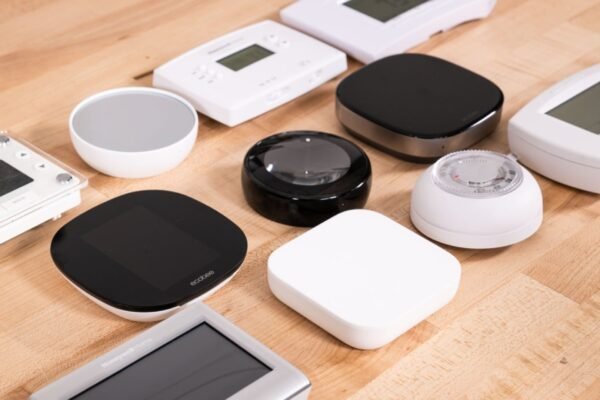
Smart LED bulbs ($8-$15 each) add scheduling, dimming, and color tuning to the efficiency equation. The real savings come from automation: lights that turn off when rooms are empty, dim in the evening, and follow schedules. A bulb that never gets left on all day saves more than any efficiency rating.
Don’t forget fixtures: dirty fixtures and shades block surprising amounts of light, making you use brighter bulbs than needed. Clean them annually. And when an LED finally dies in a decade, recycle it; many contain small amounts of electronics that shouldn’t go in landfills. Retailers like Home Depot and IKEA accept them.
- Automate with smart bulbs. Schedules and occupancy sensing eliminate the biggest waste: lights left on.
- Use dimmers. Dimmed LEDs use proportionally less power. $15 dimmer switches pay back fast in living areas.
- Clean fixtures yearly. Dust and grime block light output. Clean shades mean you need fewer lumens.
- Replace high-use bulbs first. Kitchen, living room, porch: the bulbs on 5+ hours daily pay back fastest.
- Recycle old bulbs. LEDs contain electronics; CFLs contain mercury. Retailers and municipalities accept both.
- Calculate the payback. A $3 LED replacing a 60W bulb used 3 hrs/day saves ~$7/year. Payback in months, then pure savings.
Frequently Asked Questions
Are LED bulbs really worth the higher price?
Absolutely. A $3 LED uses 75% less electricity and lasts 15-25x longer than incandescent. Typical payback is under a year for frequently used bulbs, then it’s pure savings for a decade.
What does 2700K vs 5000K mean?
Kelvin measures color temperature: 2700K is warm yellowish (cozy), 3000K neutral warm, 4000K+ cool white to bluish (clinical). Match the temperature to the room’s purpose.
Do LEDs work with dimmer switches?
Only if both the bulb and dimmer are LED-compatible. Old dimmers cause flickering with LEDs; a $15 LED-rated dimmer switch solves it. Check bulb packaging for ‘dimmable.’
Beginner Mistakes That Cost Time and Money
Every DIYer pays tuition in mistakes; the goal is to learn from other people’s instead of your own. These are the errors I see beginners make repeatedly, and each one is completely avoidable once you know to watch for it.
- Skipping prep. The unglamorous preparation (cleaning, masking, measuring) determines 80% of the final quality. Rushing it is the classic false economy.
- Buying the cheapest materials. Bargain supplies fail faster and work worse, costing more in redos than quality materials cost upfront.
- Not measuring twice. The old saying survives because it’s true. Five minutes with a tape measure prevents hours of rework.
- Starting late in the day. Begin projects in the morning. Running out of daylight mid-project forces rushed, sloppy finishing.
The bottom line: The best energy-efficient light bulbs for every room are LEDs chosen by lumens for brightness and Kelvin for mood: warm dimmable 2700K for living spaces, bright neutral 3000K for kitchens and baths, cooler task lighting for offices. Add automation so they’re never left on needlessly, and your lighting bill shrinks by three-quarters.