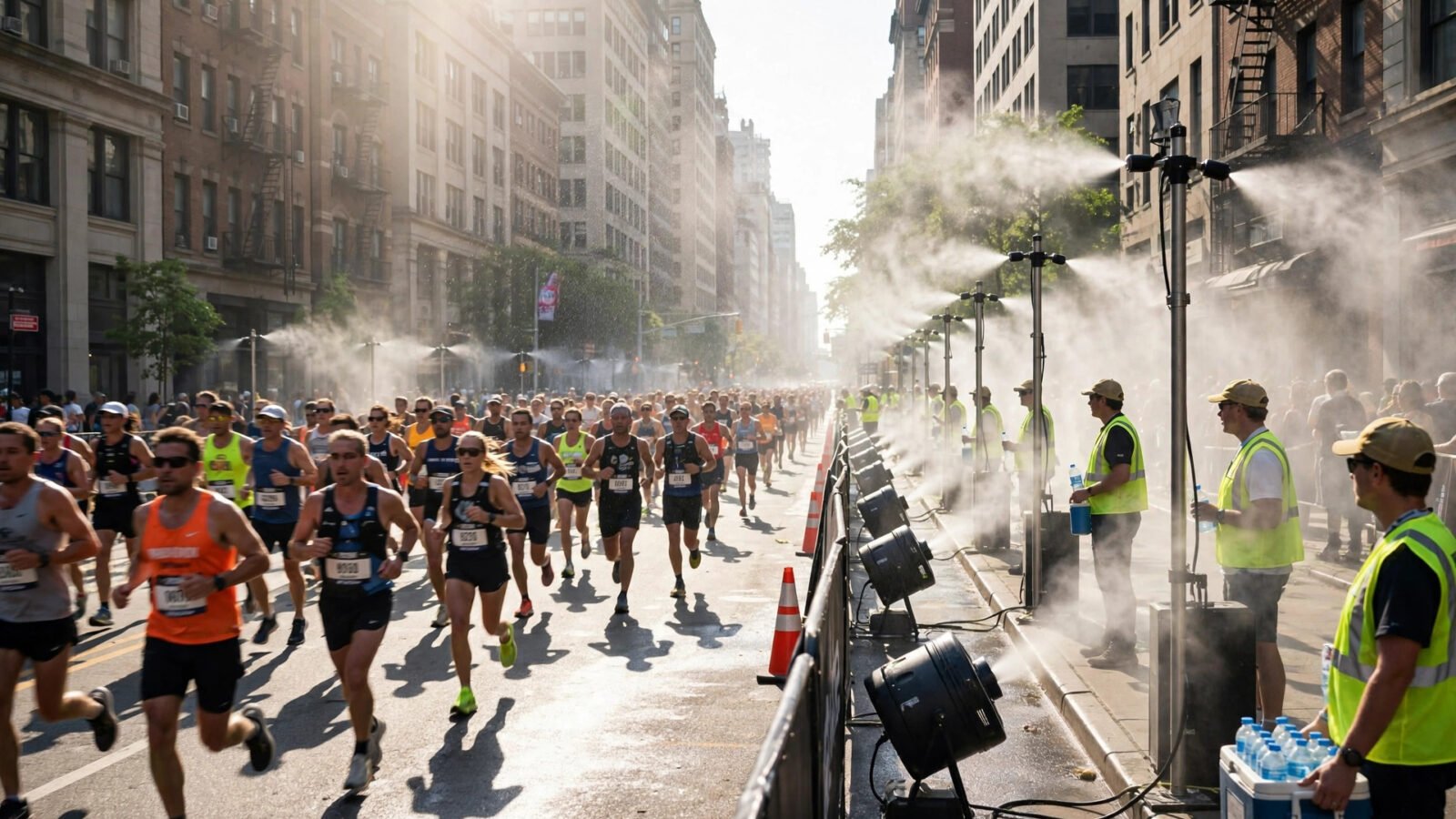
In the summer of 2021, the Tokyo Olympics marathon was moved 500 miles north to Sapporo to escape the heat — and it was still brutally hot. Runners collapsed. Race organizers sprayed mist on the course. It was a preview of the new reality: climate change isn’t a distant threat to outdoor sports. It’s the current scheduling department.
From youth soccer tournaments canceled for extreme heat to ski seasons measured in weeks instead of months, warming temperatures, wildfire smoke, and intensifying storms are forcing every level of sport to rethink when, where, and how games happen. The outdoor sports calendar that held for a century is being rewritten in real time.
Heat: The Defining Challenge
Extreme heat is now the single biggest climate disruptor in sports. The physics are unforgiving: human performance degrades sharply above certain wet-bulb temperatures, and heat illness can turn fatal in minutes. Marathons that once started at 9 a.m. now start at dawn or have moved to cooler months entirely. The 2022 World Cup in Qatar was shifted to November-December — the first winter World Cup — because a summer tournament in the Gulf was medically indefensible.
American sports are adapting unevenly. The NFL has long scheduled early-season games with heat in mind, but preseason practices in the Southeast now routinely feature modified schedules, cooling stations, and strict work-rest ratios. High school football — where heat-stroke deaths have occurred during August two-a-days for decades — has seen states adopt progressively stricter acclimatization rules, and the CDC’s extreme-heat guidance is now standard reading for athletic trainers. Tennis has its heat rule; the Australian Open’s extreme-heat policy, with its court-surface temperature triggers, has become the template other tournaments study.
For everyday athletes, the adaptation is simpler but no less real: summer training has migrated to 5 a.m. or after sunset. Anyone picking up running now needs beginner running tips that include heat safety — hydration timing, recognizing heat-exhaustion symptoms, and knowing when to simply move the workout indoors.
Wildfire Smoke: The New Rain Delay
A decade ago, almost no sports league had an air-quality policy. Then came the era of orange skies: the 2020 West Coast wildfire season that turned day into dusk across California and Oregon, the 2023 Canadian wildfires that sent hazardous smoke down the entire Eastern Seaboard and postponed MLB games in New York, Philadelphia, and Washington. Suddenly, the Air Quality Index became as important as the radar.
Leagues scrambled to write rules that hadn’t existed. MLB, the NFL, and MLS all developed AQI thresholds for postponement. Youth leagues — with the least medical infrastructure and the most vulnerable athletes — faced the hardest calls: canceling tournaments with hundreds of traveling families based on a number on a phone app. The EPA’s wildfire smoke resources have become unlikely required reading for tournament directors.
The deeper problem is that smoke season now overlaps with traditional fall sports calendars in the West. Cross-country — a sport built on deep breathing — has been hit especially hard, with championship meets relocated or rescheduled two years running in some states.
Hurricanes and the Reshaped Fall Calendar
The Atlantic hurricane season has grown longer and more intense, and college football — concentrated in the Southeast — feels it every fall. Games get moved, postponed, or relocated with increasing frequency. The logistical chaos extends beyond the game itself: displaced teams, disrupted travel, stadiums doubling as emergency shelters.
Spring sports face their own version: baseball and softball seasons in the South now routinely lose weeks to severe-weather outbreaks, compressing schedules and forcing doubleheaders that strain young arms. Golf tournaments, tennis events, and motorsports all build bigger weather buffers into their calendars than they did twenty years ago.
Winter Sports Are Running Out of Winter
The most existential climate story in sports belongs to winter. Natural-snow ski seasons across the American West and Northeast have shortened measurably; resorts that once opened at Thanksgiving now target mid-December, and closing dates creep earlier. The economics are brutal — a lost Christmas week can wreck a resort’s entire season — which is why the ski industry has become one of the most aggressive corporate voices on climate policy.
The Winter Olympics face a startling future. Researchers have projected that by mid-century, only a handful of previous host cities will reliably have the snowpack and temperatures to host the Games again. The IOC has responded by elevating venue climate reliability to a top-tier selection criterion and openly discussing rotating the Winter Games among a small set of climate-resilient sites. Entire sports — outdoor speed skating on natural ice, for instance — are already essentially extinct at the elite level in their traditional forms.
For recreational winter athletes, the adaptation is already priced in: more reliance on snowmaking, more travel to high-altitude resorts, and seasons planned around increasingly uncertain opening days.
How Leagues and Organizers Are Adapting
The adaptation playbook is now fairly standardized. Schedules shift: more night games, earlier or later seasons, built-in weather weeks. Infrastructure hardens: stadiums add cooling systems, tournaments invest in air-quality monitoring, ski resorts pour money into snowmaking. Policies formalize: heat rules, AQI thresholds, lightning protocols get written down and enforced.
The most forward-thinking organizations are doing scenario planning — modeling what their sport looks like at 1.5 or 2 degrees of additional warming and working backward to today’s decisions. Youth sports organizations, operating on thinner margins, adapt more improvisationally: flexible scheduling, indoor backup plans, and a growing willingness to simply cancel. The era of “the game must go on” is giving way to “the kids must be safe.”
The Youth Sports Front Line
No population is more affected, or less equipped to adapt, than young athletes. Children overheat faster than adults, are less likely to recognize warning signs, and often won’t self-advocate to stop playing. Pediatric sports-medicine specialists have become some of the loudest voices for heat-safety reform, pushing for mandatory cooling breaks, shaded rest areas, and coach education.
Parents are adapting too — sometimes by switching sports entirely. Families in the hottest regions increasingly steer kids toward indoor sports or water sports, a quiet migration that may reshape youth participation maps over the coming decade. The simple health calculus still favors getting kids moving — daily walking’s health benefits don’t require a 100-degree practice field — but the conditions of play are changing.
What Athletes Are Doing Differently
Elite athletes have responded with science: heat-acclimation protocols (10–14 days of progressive heat exposure before competition), pre-cooling strategies (ice vests, cold towels, slushie drinks — yes, really), and personalized hydration plans built on sweat-rate testing. What was once exotic sports science is now standard practice at the Olympic level.
The amateur version is simpler: train early or late, hydrate before you’re thirsty, learn the difference between heat exhaustion and heat stroke, and respect the AQI the way you respect lightning. The athletes thriving in the new climate aren’t the toughest — they’re the most adaptable.
Climate change didn’t just add a new variable to outdoor sports — it became the variable, the background condition against which every schedule, every venue decision, and every safety protocol is now written. The sports that thrive in the coming decades will be the ones that treat adaptation as strategy rather than inconvenience. The games will go on. They’ll just go on at dawn, under lights, in different months, in different places — and increasingly, on nature’s terms rather than ours.
Frequently Asked Questions
How is climate change affecting sports schedules?
Extreme heat is pushing events to earlier/later times and cooler months, wildfire smoke is causing postponements based on air-quality thresholds, hurricanes are disrupting fall seasons, and winter sports face shortening seasons from declining snowpack.
What temperature is too hot to play sports?
It depends on humidity (measured as wet-bulb globe temperature), but most guidelines call for modifying or canceling activity when the heat index exceeds 104°F, with increasing precautions starting around 91°F. Youth athletes need stricter thresholds than adults.
Will the Winter Olympics survive climate change?
Researchers project sharply declining numbers of viable host cities by mid-century. The IOC now prioritizes climate reliability in host selection and has discussed rotating among climate-resilient venues.
How do athletes train in extreme heat safely?
Through heat acclimation (gradual exposure over 10–14 days), training during cooler hours, aggressive hydration, pre-cooling strategies, and strict work-rest ratios — plus knowing when conditions are simply unsafe.


