What Is 4 High, Exactly?
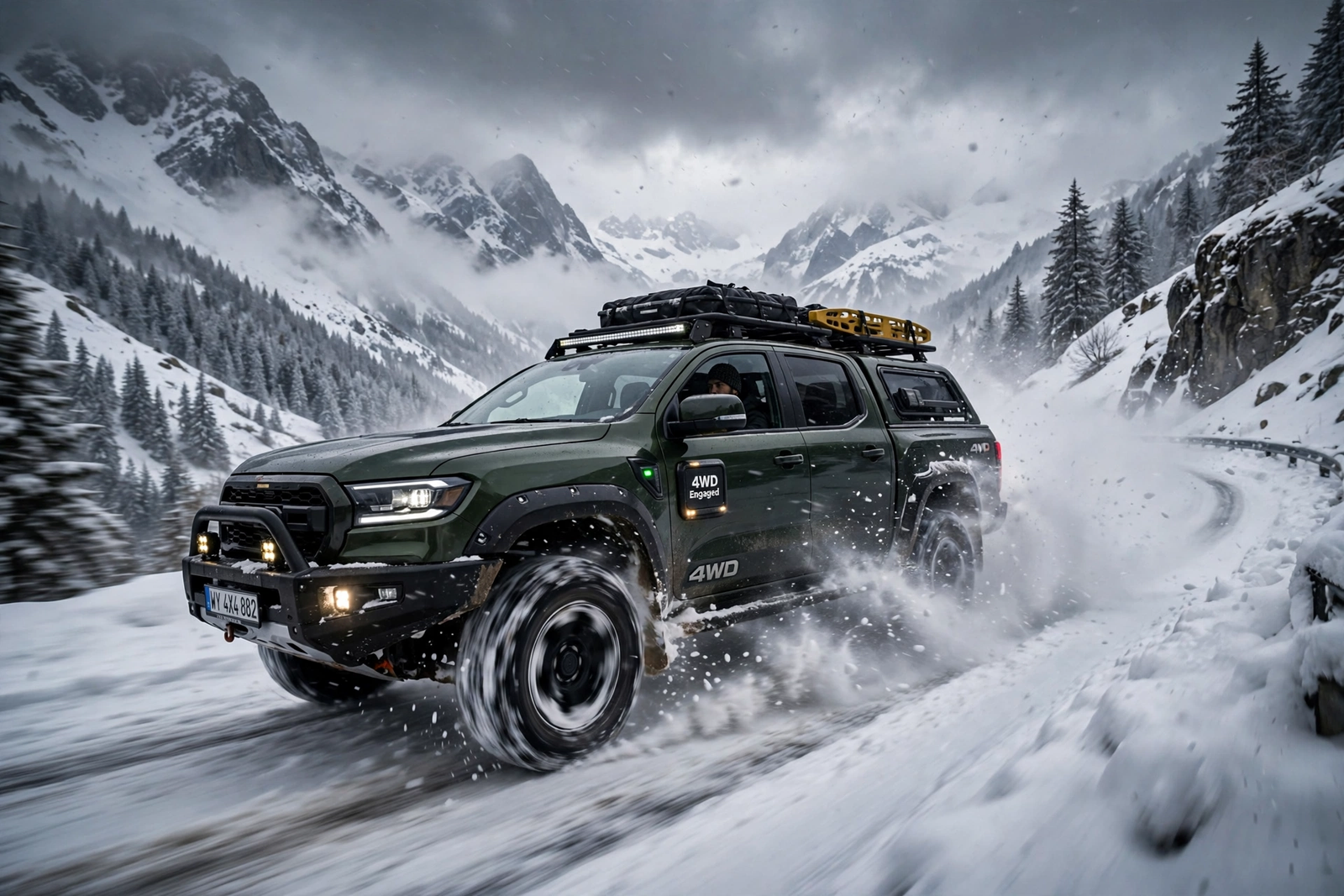
4WD High (4H) locks the front and rear axles together at a 1:1 gear ratio — same as normal driving, but with power going to all four wheels. It’s designed for higher-speed driving on low-traction surfaces: snowy highways, rainy roads, gravel, sand, and light mud.
Contrast with 4 Low (4L), which multiplies torque for crawling — rock crawling, deep mud, steep climbs — at speeds under 25 mph. And 2WD/Auto for normal dry-road driving.
Safe Speed Limits in 4 High
- General safe maximum: 55–60 mph — the widely accepted limit
- Some manufacturers (Jeep, Ford, Toyota): allow shifting into 4H at speeds up to 55 mph, and driving at highway speeds in appropriate conditions
- Practical advice: if conditions warrant 4WD, you probably shouldn’t be doing 70+ anyway — slippery surfaces demand slower speeds regardless of drivetrain
Check your owner’s manual — limits vary. The Jeep 4×4 systems guide explains the differences between their Command-Trac, Selec-Trac, and Rock-Trac systems nicely.
When to Use 4 High
- Snow and ice — the classic use case
- Heavy rain on highways (reduces hydroplaning risk)
- Gravel and dirt roads
- Sand (with reduced tire pressure)
- Light mud
When NOT to Use 4 High
- Dry pavement — never. On high-traction surfaces, locked axles can’t rotate at different speeds in turns, causing drivetrain binding (“crow hop”). This stresses and can break the transfer case, differentials, and axles — a $2,000–$4,000 mistake.
- Tight parking maneuvers even on slippery surfaces — the binding effect is worst in sharp turns
- Once conditions improve — shift back to 2WD as soon as you’re on clear pavement
How to Engage 4 High Properly
- While moving: most modern part-time 4WD systems allow shifting into 4H at speeds up to 55 mph — just turn the dial or pull the lever
- Straight line preferred: engage while driving straight, not mid-turn
- Listen and feel: you’ll hear a clunk and possibly feel a slight lurch — that’s normal
- Disengage the same way: shift back to 2H while moving straight; you may need to briefly reverse a few feet if it won’t disengage (relieves binding)
If your 4WD won’t engage, the actuator or vacuum system may need service — don’t force it. Regular how often should you service your car“>scheduled maintenance should include transfer case fluid checks, which many owners neglect.
Common 4WD Mistakes That Cause Damage
- Driving on dry pavement in 4H — the #1 transfer-case killer
- Mismatched tires — different diameters front/rear force the system to fight itself; keep all four tires the same size and similar wear (see how often should you get your tires rotated complete answer“>tire rotation schedules)
- Never using 4WD — seals dry out and actuators seize; engage 4H for a few miles monthly to keep everything lubricated
- Towing in 4WD on pavement — same binding problem, amplified
4WD Maintenance Most Owners Neglect
4WD systems need attention even when you rarely use them:
- Exercise it monthly. Engage 4H for a few miles on a loose surface (gravel road, wet grass) every month. This circulates lubricant, keeps seals pliable, and prevents actuator seizure — the most common “4WD won’t engage” cause is simply disuse.
- Change transfer case fluid every 30,000–60,000 miles (check your manual). It’s a $100–$150 service that prevents $2,000+ transfer case failure.
- Change front and rear differential fluid on a similar schedule — especially if you tow or off-road.
- Keep all four tires matched. Different tread depths or sizes front-to-rear make the system fight itself, accelerating wear on the transfer case chain and clutches. This is another reason how often should you get your tires rotated complete answer“>regular tire rotation matters doubly on 4WD vehicles.
The Jeep 4×4 guide has model-specific maintenance schedules, but the principles apply to Ford, Toyota, GM, and Ram systems too. If your 4WD warning light comes on, don’t ignore it — electronic transfer case actuators are far cheaper to fix when caught early.
Full-time vs. part-time 4WD: know which you have
Part-time 4WD (most trucks: 2H/4H/4L selector) must not be used on dry pavement. Full-time 4WD / AWD (many SUVs) has a center differential and is safe everywhere. Using part-time 4H on dry pavement is the single most expensive mistake — check your dash indicator and owner’s manual if you’re unsure which system you have.
Frequently Asked Questions
Can you drive 70 mph in 4 High?
Mechanically possible on some vehicles, but not advisable — if you need 4WD, conditions don’t justify 70 mph. Slow down.
Is it bad to drive in 4 High on the highway in snow?
No — that’s exactly what it’s for. Just keep speeds reasonable for the conditions and shift back to 2WD when the road clears.
What’s the difference between 4H and AWD?
AWD is full-time with a center differential allowing speed differences (safe on dry pavement). Part-time 4H locks axles together (not safe on dry pavement). Don’t confuse them.
Why does my truck jerk when turning in 4WD?
That’s drivetrain binding — you’re likely on too much traction for 4WD. Shift back to 2WD immediately.
Can I shift into 4 High while moving?
Yes, on most modern systems — up to ~55 mph, driving straight. Older manual-hub systems may require stopping.
Does 4WD help you stop faster?
No. 4WD helps you go; it does nothing for braking. Icy stopping distances are the same in 2WD and 4WD — another reason to slow down. For overall winter readiness, review how long does a transmission last complete answer“>drivetrain maintenance before the season hits.