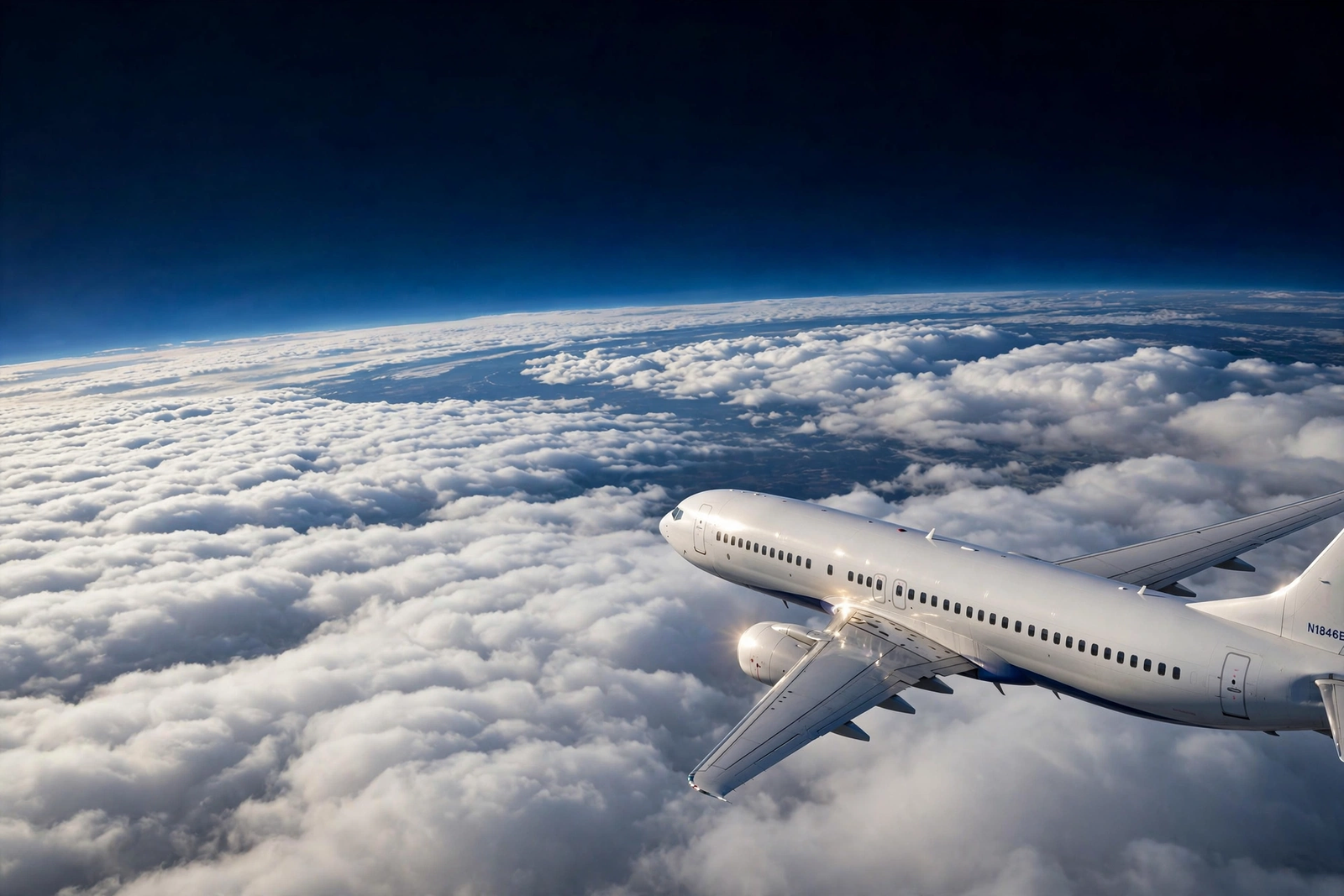
Look out of an airliner window at cruising altitude and the world below looks like a map: clouds as scattered cotton, cities as faint smudges, the horizon curving gently away. It feels impossibly high. But that altitude — roughly seven miles up — was not chosen for the view. It is the product of physics, economics, weather, and a century of aviation engineering, and different kinds of aircraft fly at very different heights for very different reasons.
How High Commercial Airliners Fly
The short-haul jet taking you on a two-hour hop and the wide-body crossing an ocean both cruise in the same band: 30,000 to 40,000 feet. In aviation terms, that is Flight Level 300 to Flight Level 410 (FL300–FL410), where each flight level represents 100 feet of altitude measured against standard air pressure.
Most flights do not pick one altitude and stay there. A typical long-haul flight climbs in steps: it might start cruising at 33,000 feet, then climb to 35,000, 37,000, and eventually 39,000 or 41,000 feet as it burns fuel and gets lighter. Pilots call this a step climb, and it keeps the aircraft at its most efficient altitude throughout the journey. Shorter flights may never get past 30,000 feet simply because there is not enough time to climb higher before descending again.
Why Airliners Cruise at 35,000 Feet
The choice of cruising altitude is a careful balancing act. Several forces all point to roughly the same sweet spot:
Thinner air means less drag — and less fuel
Jet engines and wings both work in air, and air gets thinner with altitude. At 35,000 feet, the air is only about a quarter as dense as at sea level. Less dense air means less drag on the airframe, so the engines burn significantly less fuel to maintain speed. Since fuel is an airline’s biggest operating cost, flying high is flying cheap. This is the single biggest reason your flight goes up to seven miles.
Above most of the weather
The cruising band sits above the worst of the troposphere’s weather. Thunderstorms, which can top out around 40,000–50,000 feet in extreme cases, are mostly avoided, and the ride is smoother above the turbulent lower layers. Pilots still route around the tallest storm cells, but day-to-day bumps are far less common at FL350 than at 20,000 feet.
The jet stream advantage
High-altitude winds — the jet streams — blow at exactly these altitudes, sometimes exceeding 200 mph. A flight from New York to London rides the eastward jet stream like a conveyor belt, arriving faster and burning less fuel; the return leg fights it, which is why westbound transatlantic flights take noticeably longer. Airlines plan routes around these winds every single day.
Engine and wing efficiency
Modern turbofan engines are designed to be most efficient in cold, thin air. At 35,000 feet the outside temperature is around −54°C (−65°F), which suits the thermodynamics of the engine cycle. Wings, too, are optimized for these conditions — which is why the cruising altitude of a 737 and an A380 are so similar despite their enormous size difference.
Why Not Fly Even Higher?
If thinner air is better, why stop at 40,000 feet? Because the benefits taper off while new problems appear:
- Pressurization limits. Cabin air is kept at the equivalent of about 6,000–8,000 feet. The higher the aircraft flies, the greater the pressure difference the fuselage must withstand, cycle after cycle, for decades. Going higher means heavier, more expensive structures.
- The coffin corner. At very high altitudes, the gap narrows between the speed at which the wing stalls and the speed at which shock waves form over it. Pilots call this shrinking margin the “coffin corner,” and it leaves little room for error — one reason airliners stay well below it.
- Engine limits. Jet engines need air to breathe. Above roughly 45,000 feet, there simply is not enough oxygen density for conventional airliner engines to produce reliable thrust.
- Emergency descent. If the cabin loses pressure, the crew must descend to breathable altitudes quickly. Starting from 60,000 feet, that descent takes dangerously long.
The 30,000–40,000-foot band is where all these trade-offs balance. It is no accident — it is an optimum discovered over decades and confirmed by every major airliner flying today. You can learn more about the technical definition in Wikipedia’s explanation of flight levels.
Private Jets: Higher Than the Airlines
Business jets routinely cruise at 41,000 to 51,000 feet — noticeably above the airline traffic. A Gulfstream G700, for example, can cruise at 51,000 feet. There are good reasons for this:
First, separation. Flying above FL410 puts private jets in thinner airspace with far less traffic, so they get more direct routings and fewer delays. Second, the same fuel-efficiency logic applies even more strongly to small jets. Third, at 45,000+ feet you are above virtually all weather and most turbulence — owners paying for a private jet expect a smooth ride.
The trade-off is that business jet cabins must handle a bigger pressure differential, and their smaller wings operate closer to their limits. But with lighter loads and sophisticated systems, the math works — which is why the sky above the airliners belongs largely to private aviation.
Military Aircraft: The Real Altitude Champions
Military jets play by different rules, and their altitudes reflect it:
- Fighter jets like the F-22 Raptor and Eurofighter Typhoon can operate above 60,000–65,000 feet. Altitude is life in air combat: it gives missiles more range and puts the aircraft above most threats.
- The SR-71 Blackbird, the legendary Cold War reconnaissance jet, cruised above 85,000 feet — over 16 miles up — at more than three times the speed of sound. At that altitude, pilots wore full pressure suits, essentially astronaut gear, and could see the curvature of the Earth.
- The Concorde, the supersonic airliner, cruised at around 60,000 feet — far above subsonic traffic. Passengers could see the Earth’s curvature and the sky darkening toward black. Concorde’s service history on Wikipedia covers its remarkable operating envelope.
- U-2 spy planes still fly missions above 70,000 feet, in what pilots call “the edge of space” conditions.
For perspective on just how high 85,000 feet is: a commercial airliner at 35,000 feet is already above 75% of the atmosphere’s mass. The SR-71 flew in air so thin it was closer to space than to the world below.
Other Aircraft: Lower Down the Ladder
Not everything with wings goes high. For comparison:
- Small propeller planes (Cessna 172 and similar) typically fly at 3,000–10,000 feet.
- Regional turboprops cruise around 20,000–25,000 feet.
- Helicopters usually operate below 10,000 feet, often much lower.
- Hot air balloons rarely exceed a few thousand feet.
Airspace itself is layered by regulation. In the US, for instance, controlled high-altitude airspace (Class A) runs from 18,000 feet up to 60,000 feet — the FAA’s Pilot’s Handbook of Aeronautical Knowledge explains how these layers keep traffic safely separated.
What It Feels Like Up There
Inside the cabin, you would never guess the altitude. Pressurization keeps the cabin at a comfortable equivalent of 6,000–8,000 feet — roughly the altitude of Denver or Mexico City. That is why your ears pop on the way up and why some people feel slightly more tired after long flights: you are breathing air with a bit less oxygen than at sea level for hours.
Outside, conditions are brutal: −54°C temperatures, air too thin to breathe, and ultraviolet radiation far stronger than at the ground. The fuselage is the only thing between you and an environment that would kill in minutes — which makes the routine smoothness of a cruise at 35,000 feet one of engineering’s quieter miracles.
For a sense of scale, an airliner’s cruising altitude is roughly 70 times the width of a football field stacked vertically — and a school bus parked end to end at about 40 feet long would need more than 850 of them bumper to bumper to reach the same height.
Frequently Asked Questions
How high do aeroplanes fly in feet?
Commercial airliners cruise between 30,000 and 40,000 feet, most commonly around 35,000 feet. Private jets fly higher, up to about 51,000 feet, and military aircraft can exceed 60,000–85,000 feet.
How high do planes fly in kilometres?
A typical airliner cruising altitude of 35,000 feet equals about 10.7 kilometres — roughly 10,668 metres. The full commercial range of 30,000–40,000 feet converts to about 9 to 12 kilometres.
Why do planes fly so high?
Thinner air at altitude means less drag and lower fuel burn, the engines run more efficiently in cold air, flights stay above most weather and turbulence, and they can ride high-altitude jet stream winds. It is the sweet spot where economics, comfort, and safety all align.
What is the highest a passenger plane has flown?
Concorde, the supersonic airliner, routinely cruised at about 60,000 feet — the highest of any scheduled passenger service. No subsonic airliner comes close; they top out around 41,000–43,000 feet.
Can planes fly above storms?
Mostly, yes. Ordinary thunderstorms top out well below cruising altitude, so airliners fly serenely above them. Only the most violent storm cells reach 40,000–50,000 feet, and pilots route around those using onboard weather radar.
Do planes ever fly at 50,000 feet?
Private and business jets do — many are certified to 45,000–51,000 feet. Commercial airliners do not; their certified ceilings top out around 41,000–43,000 feet, and they cruise lower for efficiency and safety margins.
So the next time you are at 35,000 feet watching the clouds drift by seven miles below, you will know exactly why you are up there: thinner air, cheaper fuel, smoother skies, and a tailwind doing half the work. It is not the highest humans can fly — not even close — but for moving hundreds of people safely and economically, it is just right.





One thought on “How High do Aeroplanes Fly: What You Need to Know”