The most productive meeting of your week might be the one where nobody sits down. Walking meetings — conducting one-on-ones, brainstorms, and check-ins on foot instead of around a conference table — have evolved from Silicon Valley quirk to mainstream productivity practice. The pitch is seductive: burn calories, clear your head, and get better ideas, all without scheduling extra time. But why walking meetings are the new fitness hack goes deeper than step counts — the research on creativity, mood, and decision quality makes a compelling case that we should have been walking all along.
The concept is ancient — Aristotle’s peripatetic school literally taught while walking — but the modern evidence base is new and surprisingly robust. Here is what the science says, how to run walking meetings that actually work, and where the practice hits its limits.
The science: what walking does to your brain
The headline finding comes from Stanford research showing that creative output increases substantially while walking — with the boost persisting briefly even after sitting back down. The mechanism is not fully settled, but the leading theories involve increased cerebral blood flow, the rhythmic bilateral stimulation of walking (similar to mechanisms in certain therapies), and the way movement loosens the associative thinking that fuels divergent creativity. Anecdotally, anyone who has solved a stuck problem mid-walk knows the feeling; the research confirms it is not imagination.
Mood effects are equally well-documented. Walking — even briefly — reduces anxiety and rumination while improving affect, and outdoor walking adds the well-established benefits of nature exposure and sunlight. For the health benefits of walking 30 minutes a day, the evidence spans cardiovascular health, metabolic function, and longevity — a walking meeting that covers a mile quietly banks a meaningful fraction of the daily activity that transforms health outcomes. The CDC’s physical activity research and the American Heart Association’s walking guidance both underscore that accumulated moderate activity — however it is scheduled — is what matters.
Why meetings specifically benefit
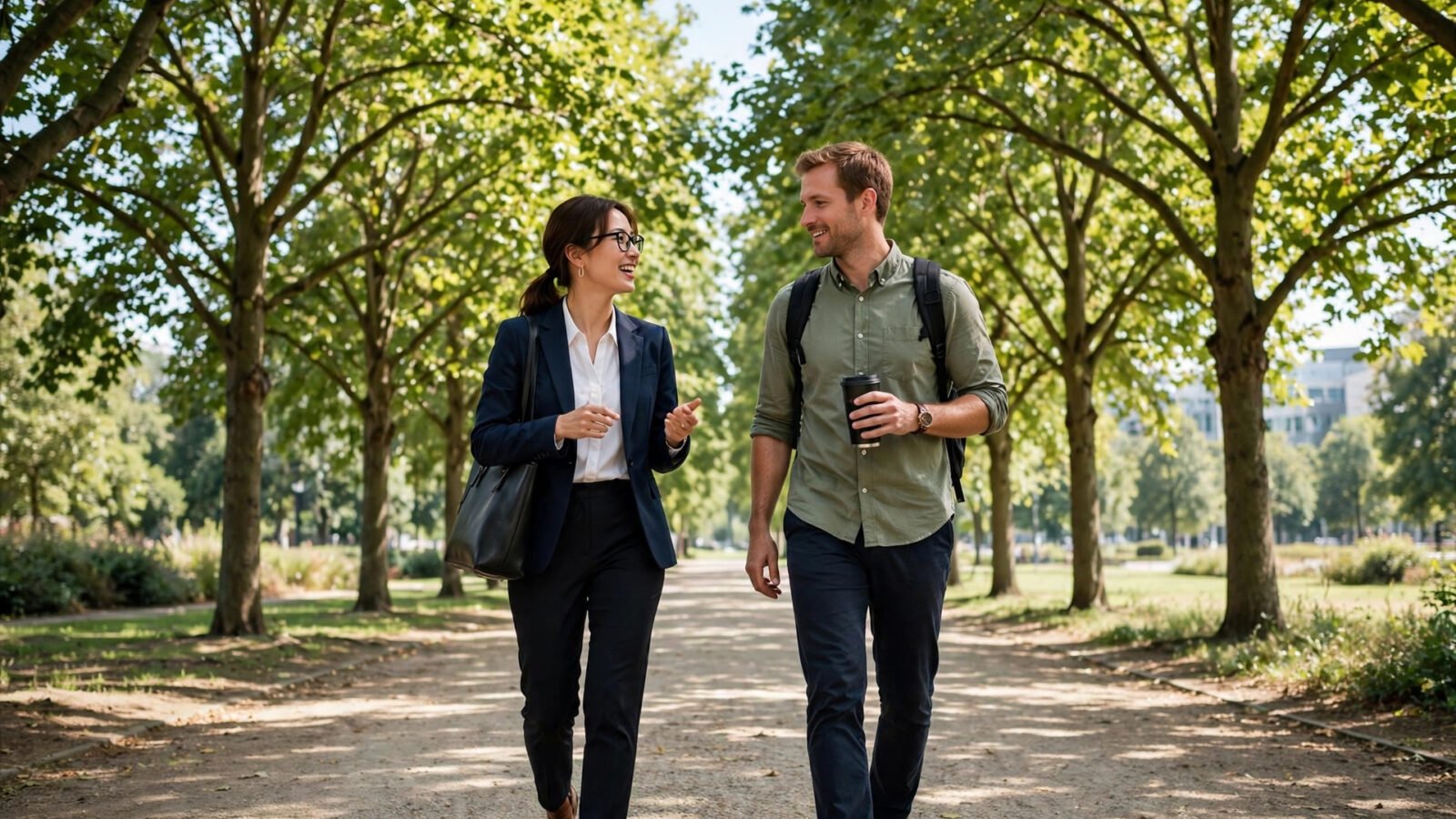
Meetings are where walking’s advantages compound. The side-by-side format (no sustained eye contact) makes difficult conversations easier — feedback, disagreements, and sensitive topics flow better shoulder-to-shoulder than across a table, a dynamic therapists have long exploited in walk-and-talk sessions. Hierarchy flattens outdoors: it is hard to pull rank on a trail. Phone-staring and laptop multitasking — the twin plagues of conference rooms — become physically impossible, forcing the presence that meetings are supposed to have. And the shared mild exertion builds rapport faster than any icebreaker; teams that walk together report stronger cohesion.
Walking’s famous practitioners
The practice has a distinguished pedigree. Charles Darwin built a thinking path at his home and walked it daily while working through natural selection. Beethoven carried manuscript paper on long walks through the Vienna woods. Steve Jobs was famous for walking meetings, and numerous founders and executives swear their best decisions happened on foot. The pattern across centuries is consistent: people doing the hardest thinking of their era chose to do it moving. The modern office, with its chairs and conference tables, is the historical anomaly — walking meetings are a return to the default.
How to run walking meetings that work
Not every meeting should walk. The sweet spot: one-on-ones, brainstorms, coaching conversations, walking interviews, and status check-ins — meetings driven by conversation rather than documents. Skip walking for: anything requiring screens, slides, or detailed documents; large groups (beyond three or four, conversation fragments); formal negotiations or performance reviews needing privacy and notes; and anyone with mobility limitations — inclusivity is non-negotiable, so always offer the seated alternative without making it awkward.
Logistics determine success. Plan a route in advance — a 30-minute meeting needs roughly a 1.5-mile loop, a 60-minute one about 3 miles at conversational pace. Choose paths with minimal traffic noise, safe crossings, and (ideally) greenery. Set the agenda before stepping out: walking meetings without structure drift into pleasant but unproductive strolls. Assign one person to capture notes — voice memos work, or a quick 5-minute seated debrief afterward to record decisions. Dress-code reality: walking meetings quietly killed the “meeting heels” era, and workplace norms are adapting. Track the activity honestly — walkers often discover their realistic daily step goal for a sedentary person is suddenly within reach when meetings become movement.
The organizational playbook
Companies serious about walking meetings build infrastructure: mapped walking routes near the office with distance markers, a cultural norm that walking meetings are default for suitable formats, calendar integrations suggesting walk-friendly slots, and leadership visibly participating — nothing normalizes a practice like the CEO doing one-on-ones on foot. Remote teams adapt with “walk and talk” phone calls — cameras off, earbuds in, both parties walking their own neighborhoods. The distributed version loses the shared scenery but keeps the cognitive and health benefits.
Measure what matters: participants consistently report higher meeting satisfaction, better idea quality, and improved energy for the rest of the day. The NIH’s research on activity and cognition provides the evidence base for skeptics who need data before changing meeting culture.
The limits — an honest accounting
Walking meetings are not universal. Accessibility is the hard constraint: any practice that excludes colleagues with mobility limitations, chronic pain, or health conditions needs careful, genuinely equivalent alternatives — not grudging accommodations. Weather and geography limit feasibility; extreme heat, cold, rain, and unsafe neighborhoods are real barriers, not excuses. Confidential topics need private settings. And some people simply think better sitting still — cognitive styles vary, and the walking evangelist should not become the walking tyrant.
The deeper caution: walking meetings optimize the meeting, but the highest-value move is often canceling it. Do not let a delightful format justify meetings that should have been messages. Walk the meetings worth having; delete the rest.
The takeaway
Walking meetings are the new fitness hack because they solve the binding constraint of adult health: time. They convert hours already committed to work into movement, creativity, and connection — no extra scheduling, no gym required. Start with one weekly one-on-one on foot. Plan the route, set the agenda, leave the laptop behind. Your step count, your ideas, and your team will thank you — preferably while moving.
Frequently Asked Questions
Do walking meetings actually boost creativity?
Yes — Stanford research found creative output increases significantly during walking versus sitting, with benefits persisting briefly afterward. The effect is strongest for divergent, brainstorming-style thinking.
What types of meetings work best as walking meetings?
One-on-ones, brainstorms, coaching conversations, and status check-ins — meetings driven by conversation. Avoid walking for document-heavy reviews, large groups, confidential topics, or anything requiring screens.
How long should a walking meeting be?
Thirty minutes covers about 1.5 miles at conversational pace; 60 minutes about 3 miles. Match the route to the agenda — plan the loop before you step out so the walk ends when the meeting does.
Are walking meetings inclusive for people with mobility issues?
They must be handled carefully — always offer a genuinely equivalent seated alternative, never pressure participation, and consider “walk and talk” phone formats where everyone moves (or does not) in their own way. Inclusivity is non-negotiable.
How do you take notes during a walking meeting?
Assign one person to capture voice memos during the walk, or hold a quick 5-minute seated debrief immediately after to record decisions and action items. Keep the agenda tight so less needs capturing.