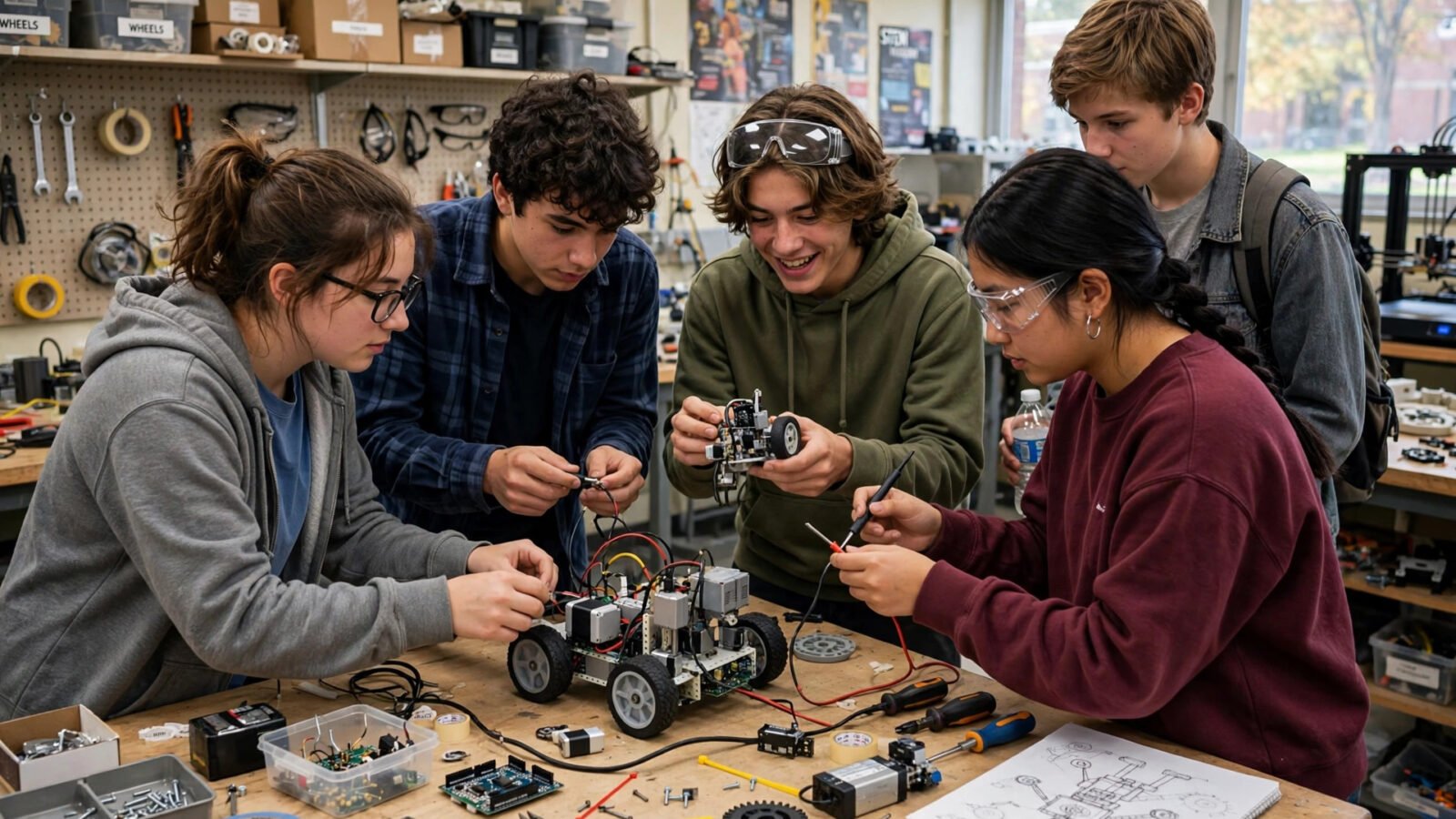
There’s a particular energy in a classroom where students are building something real — a water filtration prototype, a business plan for a local nonprofit, a documentary about their neighborhood’s history. It’s louder than a lecture hall, messier than a worksheet session, and, according to a growing mountain of evidence, more effective than either.
Project-based learning (PBL) — the model where students learn by tackling extended, real-world projects — has moved from progressive-school niche to mainstream momentum. Districts across America are redesigning curricula around it, employers are practically begging for its graduates, and researchers keep confirming what practitioners knew intuitively: we learn by doing.
What Project-Based Learning Actually Is (and Isn’t)
Let’s clear up the confusion first: PBL is not “doing a project at the end of the unit.” That’s dessert — a fun activity after the real learning happened via lecture. True PBL inverts the sequence: the project is the learning vehicle. Students encounter a driving question or real problem, then learn the content and skills they need in order to solve it. The knowledge isn’t pre-loaded and then applied; it’s acquired through the work itself.
The gold-standard framework (from the Buck Institute / PBLWorks) specifies the design elements: a challenging problem, sustained inquiry, authenticity (real-world context and impact), student voice and choice, reflection, critique and revision, and a public product. Miss several of those and you’ve got an activity, not PBL. Nail them and you’ve got the most powerful instructional model in the research literature.
The Evidence: Why It Works
The research base is now extensive and consistent. Well-implemented PBL produces learning outcomes equal to or better than traditional instruction on standardized measures — and superior outcomes on the things tests miss: critical thinking, collaboration, communication, problem-solving, and long-term retention. Students remember what they built far longer than what they memorized.
The equity findings are particularly striking. Multiple studies show PBL disproportionately benefits students who struggle in traditional settings — English learners, students from low-income backgrounds, kids who don’t thrive on lecture-and-worksheet. The model plays to diverse strengths: the student who can’t sit still through a lecture might be the team’s best builder; the quiet kid might be the best researcher. PBL widens the definition of who’s “good at school.”
The Department of Education’s research arms and independent scholars alike have documented these effects across subjects — with particularly strong results in science and social studies, where inquiry maps naturally onto the disciplines.
Why Now: The Convergence
PBL isn’t new — its roots run through Dewey and Kilpatrick a century back. What’s new is the convergence making it scalable now. First, the employer demand: the skills PBL builds (collaboration, communication, project management, creative problem-solving) are exactly what employers say graduates lack, and the Bureau of Labor Statistics projects continued growth in roles demanding exactly these capabilities.
Second, technology removed the old logistical barriers. Research, collaboration, prototyping, and publishing — all once expensive and cumbersome — are now cheap and cloud-based. A middle-school team can interview experts over video, analyze real datasets, 3D-print prototypes, and publish findings to a global audience. The infrastructure of authentic work is free.
Third, the post-pandemic rethink of schooling’s purpose. After months of remote worksheets, educators and parents alike asked what school is for — and “memorizing content you could Google” was an unsatisfying answer. PBL offers a compelling alternative purpose: learning to do meaningful work. Even self-directed learners see the parallel — learning to code from scratch works best as project-based too, building real things rather than completing tutorials.
What Great PBL Looks Like in Practice
Elementary: The community garden project
Second-graders noticing their school’s barren courtyard drive a semester-long project: researching native plants, measuring sunlight, budgeting soil and seeds, presenting a proposal to the principal, then planting and maintaining the garden. The curriculum — measurement, life science, persuasive writing, budgeting — hides inside work the kids chose.
Middle school: The water quality investigation
Students test local waterways, analyze the data, research pollution sources, and present findings to the city council — real science, real audience, real stakes. When the council actually acts on student recommendations (it happens more than you’d think), the lesson about civic agency lasts forever.
High school: The startup incubator
Students identify community problems, develop business or nonprofit solutions, build prototypes, pitch to local business leaders. The entrepreneurial framing teaches economics, communication, and resilience simultaneously — and the best programs connect students with mentors from local industry.
The Honest Challenges
PBL’s advocates sometimes oversell, so here’s the clear-eyed version. Good PBL is hard to design — far harder than lecturing. Teachers need training, planning time, and ongoing coaching; schools that mandate PBL without investing in teacher development get shallow imitations that discredit the model. Assessment is genuinely tricky: grading a collaborative project fairly, measuring individual learning within group work, and satisfying standardized-test accountability all require thoughtful systems.
There’s also the coverage concern: PBL takes time, and time spent going deep on projects is time not spent covering breadth. The best programs solve this by mapping projects carefully to standards — but it requires curriculum design discipline that not every school has. And for students who thrive on structure and clear expectations, the open-endedness of PBL can initially feel disorienting rather than liberating.
The Future: PBL Meets AI
The most exciting frontier is PBL amplified by AI. Students now have tireless research assistants, coding collaborators, design critics, and data analysts at their fingertips — which raises the ceiling on what student projects can achieve. A high-school team with AI support can do work that would have required a professional firm a decade ago.
This also raises the bar for authenticity: when AI can generate a plausible project, the value shifts to the parts AI can’t fake — real community engagement, physical prototyping, genuine stakeholder relationships. The future of PBL is more real-world, not less. And the skills it builds map directly onto self-directed adult learning — the same project-first instinct that makes learning guitar as a beginner stick (learn songs, not scales) applies to every domain.
Project-based learning is on the rise because it answers the question traditional schooling struggles with: why does this matter? When students build real things for real audiences, motivation stops being a classroom-management problem and becomes the engine. The research says it works, employers say they want it, and students — given the choice between another worksheet and building something that matters — vote with their energy every time.
Frequently Asked Questions
What is project-based learning?
An instructional model where students learn content and skills through extended investigation of real-world problems, producing public products — as opposed to learning content first via lecture and applying it in a project afterward.
Does project-based learning improve test scores?
Well-implemented PBL produces test outcomes equal to or better than traditional instruction, with superior results on critical thinking, collaboration, and long-term retention. Poorly implemented PBL (projects without rigor) does not.
Is PBL suitable for all subjects?
It works across subjects but maps most naturally to science, social studies, and interdisciplinary work. Math and foundational literacy need more careful design to ensure systematic skill-building alongside projects.
How can parents support project-based learning at home?
Encourage real-world projects (building, making, investigating), ask questions rather than giving answers, connect kids with community experts, and celebrate process and revision — not just polished final products.