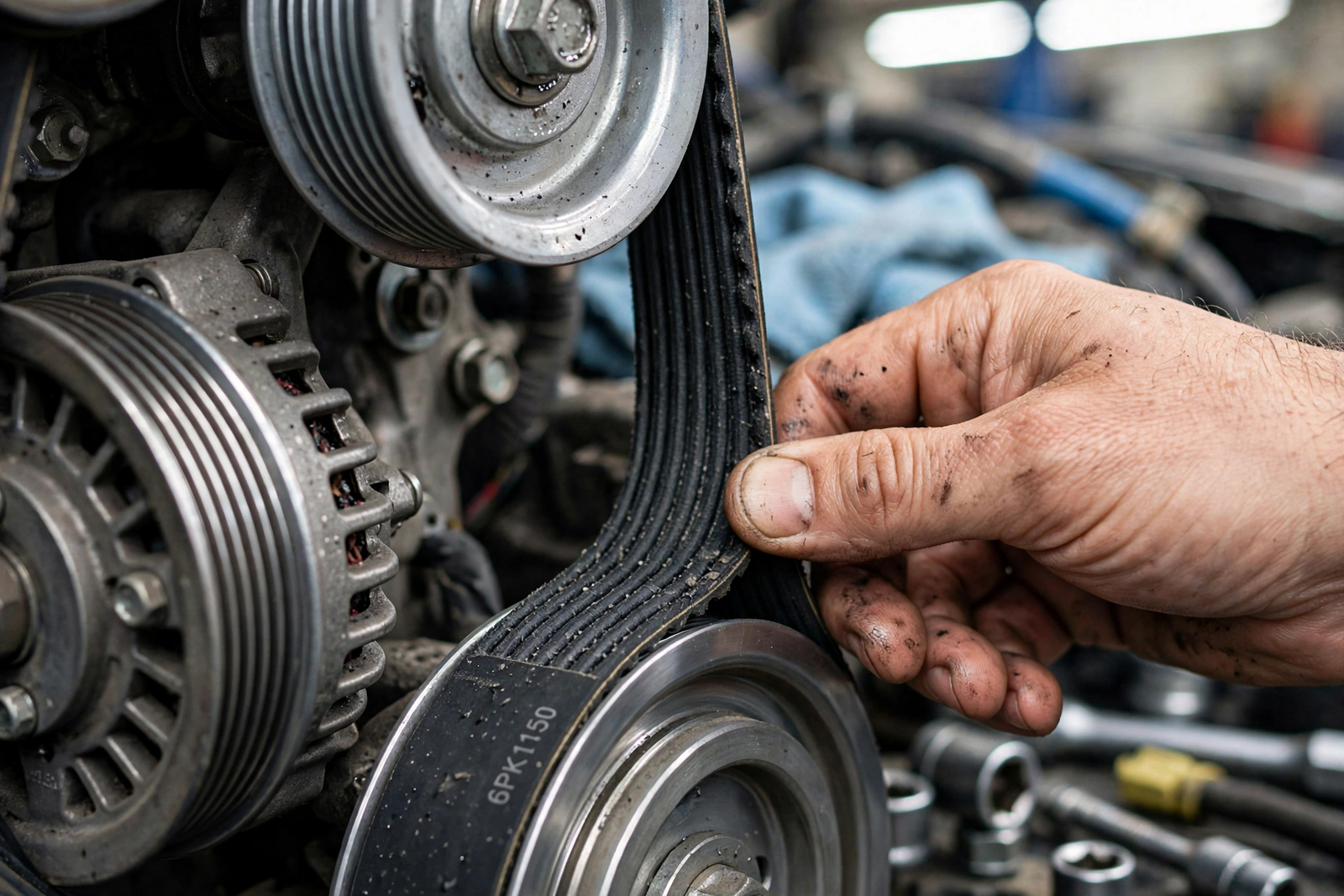
What the Serpentine Belt Actually Does
The serpentine belt is the single rubber belt that snakes around the front of your engine (hence the name) and powers nearly every accessory: the alternator, power steering pump, air conditioning compressor, and — critically — the water pump on most modern cars.
That last one is why a snapped serpentine belt is an emergency, not an inconvenience. Lose the belt and you simultaneously lose:
- Charging: the alternator stops, so the car runs on battery alone — usually 20 to 30 minutes before it dies.
- Power steering: steering becomes extremely heavy (though still possible — do not panic).
- Cooling: the water pump stops circulating coolant, and the engine can overheat within minutes.
- Air conditioning: the least of your worries, but it goes too.
Older cars used multiple V-belts, so one failure only knocked out one system. The serpentine design is more efficient and easier to service — but it is a single point of failure, which is exactly why its replacement interval matters.
How Long Does It Last? The Real Numbers
Modern EPDM rubber belts (the standard since the early 2000s) are far more durable than the old neoprene belts. Here is what to expect:
| Belt type / era | Typical lifespan | Notes |
|---|---|---|
| Modern EPDM serpentine belt | 60,000–100,000 miles | Standard on most cars built after ~2005 |
| Older neoprene belt | 40,000–60,000 miles | Found on 1990s–early 2000s vehicles |
| Severe conditions (heat, dust, short trips) | 50,000–70,000 miles | Taxi, delivery, desert climates |
| Gentle highway use | Up to 100,000+ miles | Inspect, do not assume — rubber still ages |
The mileage number gets the attention, but age matters too. Rubber degrades from heat cycling and ozone exposure even on a parked car. A 9-year-old belt with 45,000 miles on it is living on borrowed time. Most technicians suggest replacing on whichever comes first: the mileage interval or 6 to 7 years.
Your owner’s manual is the authority for your specific vehicle — some manufacturers specify 60,000 miles, others say “inspect at 60,000, replace at 100,000,” and a few list no interval at all (in which case, follow the 60k/100k convention and annual inspections).
Warning Signs Your Belt Is Wearing Out
Unlike old neoprene belts, modern EPDM belts rarely show obvious cracking before they fail — they wear by gradually losing rib material, which is harder to spot. Watch and listen for:
- Squealing or chirping on startup: the classic sign. A brief squeal in the morning that fades as the engine warms up usually means a glazed or slightly loose belt. A constant squeal means replacement time.
- Visible wear: cracks, fraying edges, missing chunks, or a shiny glazed appearance on the ribbed side. A belt wear gauge (a $10 tool) measures rib depth precisely.
- Accessories misbehaving: flickering headlights or a battery warning light (alternator under-driven), heavy steering at low speed, or weak A/C can all trace back to a slipping belt.
- Overheating: if the temperature gauge climbs and the belt looks intact, the belt may be slipping on the water pump pulley — or the tensioner has failed.
- Check engine light with accessory codes: under-voltage codes often accompany a failing belt.
Have the belt inspected at every other oil change once you pass 60,000 miles. It takes a technician about 60 seconds with the hood open — there is no reason to skip it. This fits naturally into a broader maintenance rhythm; our overview of how often to service your car shows where belt checks slot into the schedule.
What Does Replacement Cost?
Serpentine belt replacement is one of the best value repairs in all of car ownership:
- The belt itself: $25 to $75 for the part. OEM belts cost a bit more than aftermarket; Gates belt manufacturer specifications are a good reference for quality aftermarket options, since Gates supplies many factory belts.
- Labor: $50 to $150. On most cars it is a 30-to-60-minute job — release the tensioner, slip off the old belt, route the new one.
- Total typical cost: $75 to $250 at an independent shop. Dealerships run $150 to $350.
- Tensioner replacement: if the automatic tensioner is weak or noisy, add $100 to $250. Many shops recommend replacing the tensioner with the belt after 100,000 miles — it is cheap insurance since the labor overlaps.
Compare $150 against the cost of a snapped belt: a tow ($100–$200), plus potential engine damage from overheating that can run into the thousands. The AAA auto repair cost guidance consistently ranks belt replacement among the highest-value preventive services.
Some transverse-engine cars (belt crammed against the frame rail) and vehicles where the motor mount must come off can push labor toward $200 to $300. Ask for the quote upfront — but do not skip the job over an extra $50.
Can You Replace It Yourself?
Yes — this is one of the most DIY-friendly repairs on a modern car, if you can reach the belt:
- Find the belt routing diagram (usually on a sticker under the hood or in the manual). Photograph the existing routing before touching anything.
- Use a breaker bar or ratchet on the tensioner pulley to release tension and slip the belt off.
- Route the new belt per the diagram, leaving the tensioner pulley for last.
- Release the tensioner slowly, verify the belt sits centered on every pulley, and start the engine to check for noise.
The whole job takes 15 to 30 minutes with basic hand tools on an accessible engine. The main gotchas: routing the belt wrong (hence the photo), and on some cars needing to remove an engine mount or wheel-well liner for access. If the belt is buried, pay the shop — the frustration is not worth the savings.
What Happens If It Snaps While Driving?
Stay calm and act quickly:
- You will hear a snap or slapping noise, then the battery warning light comes on and steering gets heavy.
- Turn off the A/C, headlights, and every electrical accessory to conserve battery.
- Pull over safely as soon as possible. Without the water pump, the engine overheats fast — continuing to drive risks a warped head or blown head gasket, turning a $150 repair into a $2,000+ one.
- Do not try to “make it to the next exit” if the temperature gauge is climbing. Stop.
Once stopped, call for a tow. This is not a roadside fix — a new belt requires tools and the correct part. If your drivetrain has other high-mileage concerns, it may be worth reading how long a transmission lasts while you wait, to think holistically about the car’s remaining life.
Frequently Asked Questions
Can a serpentine belt last 150,000 miles?
It is possible but unwise to count on. Some belts do survive that long, especially with gentle highway use — but rubber fatigue is invisible on EPDM belts, and the failure mode is sudden, not gradual. Past 100,000 miles you are gambling a $150 preventive job against a breakdown plus potential overheating damage.
Does the serpentine belt need to be replaced with the timing belt?
Not necessarily, but it is smart. The serpentine belt must come off to access the timing belt on most engines, so the labor is already paid for — adding a $30 belt to a timing belt job is the cheapest it will ever be. If your car has a timing chain instead of a belt, this does not apply.
Why does my new serpentine belt squeal?
Usually a misaligned pulley, a weak tensioner, or contamination (coolant or oil on the belt). A glazed pulley surface can also cause it. If a brand-new belt squeals, go back to the installer — something in the drive system needs attention, not just the belt.
How do I know if my car has a serpentine belt or timing belt?
Almost every modern car has a serpentine belt (also called the accessory or drive belt) — it is visible at the front of the engine. The timing belt or chain is internal and drives the camshafts. They are different parts with different jobs and intervals; many cars have both.
Is it safe to drive with a cracked serpentine belt?
Short distances to a shop, maybe — but every mile is a gamble. A cracked belt can let go without further warning, and when it does you lose charging, power steering, and engine cooling simultaneously. If you see cracking, schedule replacement within days, not weeks.
Should the tensioner and idler pulleys be replaced too?
Inspect them at every belt change; replace if noisy, wobbly, or past 100,000 miles. Pulleys have sealed bearings that wear out on a similar timeline to the belt. Since accessing them requires removing the belt anyway, bundling the work saves a future labor charge.




One thought on “How Long does a Serpentine Belt Last? Complete Answer”