Your students can edit video, navigate algorithms, and spot a Photoshop fail — but can they tell whether the viral post they just shared is real? In an information environment of AI-generated images, synthetic video, algorithmic feeds, and industrial-scale misinformation, the answer is increasingly no. That is why media literacy is now a core classroom skill — not an elective enrichment, but foundational literacy for democratic citizenship, on par with reading and math. The states and districts treating it that way are not overreacting; they are catching up.
The urgency is empirical. Studies repeatedly find that students — and adults — perform poorly at evaluating online information: mistaking ads for articles, trusting polished misinformation, sharing false content. Meanwhile the environment gets more adversarial yearly: generative AI floods the zone with convincing synthetic media, recommendation algorithms optimize for engagement over truth, and coordinated influence operations target young people specifically. Teaching students to navigate this is no longer optional.
What media literacy actually teaches
Forget the outdated “don’t trust Wikipedia” lecture. Modern media literacy is a practical toolkit: lateral reading (verifying claims by opening new tabs and checking what trusted sources say, rather than staying on the suspicious page), source evaluation (who published this, what is their track record, who funds them), evidence assessment (does the claim cite verifiable data or just assert?), and emotional skepticism (misinformation is engineered to provoke outrage or smugness — strong emotion is a signal to slow down, not share).
For the AI era, the toolkit extends: understanding that images and video can be fully synthetic, recognizing AI-generated text patterns, knowing that “seeing is believing” died as an epistemology, and developing verification habits for the synthetic age. Students already practice informal versions — spotting AI-written reviews and telling if a photo was made by AI are media literacy in everyday clothes. The classroom’s job is making those instincts systematic, rigorous, and habitual.
The core classroom practices
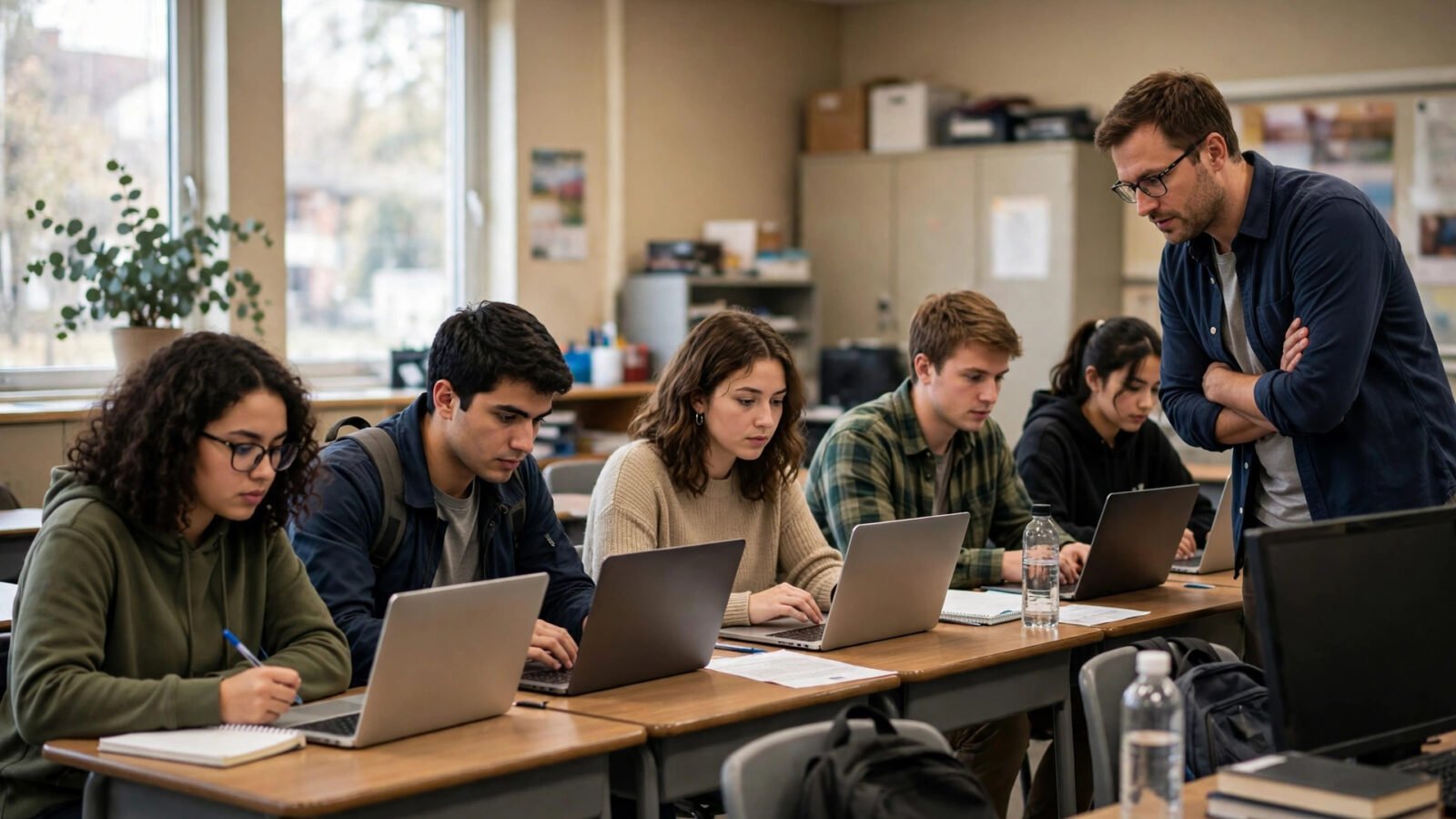
Effective media literacy instruction is hands-on, not lectured. Students analyze real viral posts (anonymized), practice lateral reading on live claims, create misinformation themselves (building a fake post teaches detection better than any lecture), debate the ethics of synthetic media, and maintain verification journals. The pedagogy that works treats students as investigators, not audiences — because the skill is practiced skepticism, and skepticism is a habit, not a fact. The National Association for Media Literacy Education’s framework provides the field’s core principles, and the Department of Education’s digital literacy resources support implementation.
The deepfake era raises the stakes
Generative AI added a new dimension: synthetic media indistinguishable from reality. Students now encounter AI-generated images in news feeds, voice clones in scam calls, and video deepfakes of public figures — and the technology improves monthly. Media literacy curricula are racing to include synthetic-media detection: understanding how generative models work (and therefore what artifacts to look for), knowing that provenance tools and watermarks are emerging but imperfect, and internalizing the core discipline that no single piece of media should be trusted on appearance alone. The students learning these skills now are the first generation for whom “seeing is believing” was never true — teaching them what replaces it is the defining educational challenge of the decade.
Why schools, why now, why core
Schools are the delivery mechanism because they reach everyone — media literacy cannot be opt-in enrichment for the already-savvy while the vulnerable go without. “Now” because the threat curve is steepening: each year of delay graduates another cohort into an environment more manipulative than the last. “Core” because the skill underlies everything else: students cannot research effectively, participate civically, or even maintain mental health (misinformation drives anxiety, polarization, and unhealthy comparison) without it.
The civic stakes deserve emphasis. Democracies depend on shared reality; misinformation fractures it. Young people are both the most targeted and the most persuadable — and the most capable of becoming the solution. A generation trained in verification is a structural defense for democratic discourse. This is not partisan: media literacy teaches method, not conclusions — how to evaluate any claim from any source, including ones you agree with. The Poynter Institute’s MediaWise program demonstrates the nonpartisan model at scale, with teen-focused verification training that works.
Implementation: making it real
The successful models integrate media literacy across subjects rather than isolating it: history classes evaluate primary sources and propaganda, science classes assess study claims and statistics, English classes analyze rhetoric and persuasion, current-events discussions practice live verification. Standalone courses work where schedules allow, but infusion reaches every student. Teacher preparation is the constraint — educators need training in the techniques themselves plus classroom-ready materials, because assigning media literacy to unprepared teachers produces the checkbox version.
Assessment should measure skills, not trivia: can students verify an unfamiliar claim? Evaluate a suspicious source? Explain their reasoning step by step? Portfolio-based assessment — collections of verified investigations — captures the competence better than any multiple-choice test ever could. And families reinforce at home: discussing the news critically at dinner, modeling verification aloud (“let me check that before I share it”), and treating media literacy as a family value, not just a school subject.
The long game
Media literacy will not eliminate misinformation — the incentives producing it are structural. But it changes the susceptibility equation: a population trained in verification is harder to manipulate, slower to share falsehoods, and more resilient in democratic discourse. The countries and states investing now are building cognitive infrastructure with generational returns.
Making media literacy a core classroom skill is education acknowledging the world as it is: every student now lives inside an information environment designed to capture attention and shape belief. Teaching them to navigate it deliberately — to verify before trusting, to investigate before sharing, to think before feeling — is not an add-on to literacy. In the 21st century, amid synthetic media and algorithmic persuasion, critical evaluation of information simply is literacy — and schools that treat it as core are preparing students for the real world they actually inhabit.
Frequently Asked Questions
What is media literacy?
The ability to access, analyze, evaluate, create, and act using all forms of communication — in practice, the skills to verify claims, evaluate sources, recognize manipulation techniques, and navigate AI-generated synthetic media critically.
Why teach media literacy in schools?
Schools reach every student, the information environment grows more manipulative yearly (especially with generative AI), and the skill underlies research ability, civic participation, and mental health. It cannot be opt-in enrichment for the already-savvy.
What is lateral reading?
A verification technique: instead of evaluating a suspicious page by reading it closely, open new tabs and check what trusted sources say about the claim and its source. It is faster and far more reliable than judging a site by its appearance.
Is media literacy political?
Done right, no. It teaches method — how to evaluate any claim from any source — not conclusions. Effective programs train students to verify claims they agree with as rigorously as those they dispute.
How can parents support media literacy at home?
Discuss news critically together, model verification aloud before sharing, ask children to explain why they trust a source, and treat healthy skepticism as a family value. The dinner-table conversation reinforces the classroom skill.