For the 7.5 million American students receiving special education services, technology was supposed to be the great equalizer — and for a long time, it underdelivered. Clunky devices, one-size-fits-all software, and tools designed without disabled users in the loop produced a graveyard of good intentions.
That’s changing. A new generation of special education technology — built with universal design principles, powered by AI, and increasingly co-designed with the disability community — is producing genuinely transformative tools. From communication devices that give non-speaking students a voice to AI tutors that adapt to dyslexic readers in real time, innovation in special education tech is having a breakthrough moment.
Communication Tech: Giving Every Student a Voice
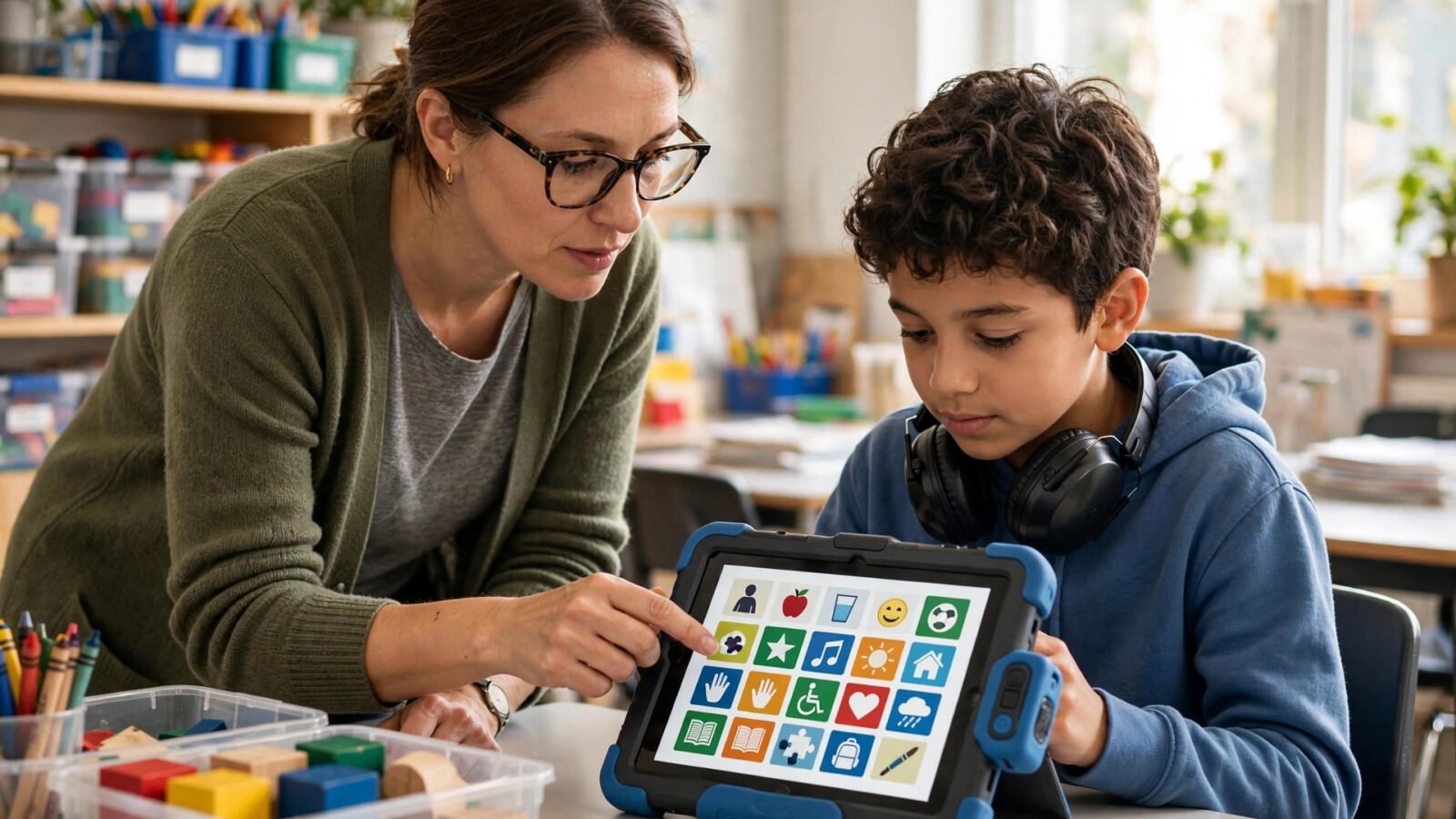
The most profound advances serve students with complex communication needs. Modern augmentative and alternative communication (AAC) — from dedicated devices to iPad apps — has been revolutionized by AI: predictive text that learns a user’s patterns, eye-gaze control precise enough for fast conversation, and natural-sounding synthesized voices (including voice banking that lets degenerative-condition students preserve their own vocal identity).
The cultural shift matters as much as the tech. The presumption of competence — the principle that non-speaking students are thinking, learning people who need a communication channel, not a cognitive verdict — has moved from activist slogan to professional standard. Schools that once warehoused non-speaking students in life-skills tracks now provide robust AAC and watch those students access grade-level curriculum. The technology didn’t create the competence; it revealed it.
AI as the Ultimate Differentiation Engine
Special education’s core challenge is differentiation — adapting instruction to wildly diverse needs within a single classroom — and AI is the most powerful differentiation tool ever built. Reading platforms now adjust text complexity sentence by sentence for dyslexic students, providing decoding support exactly where it’s needed. Math programs detect the precise step where a student’s understanding breaks down and reteach just that step. Writing tools provide real-time scaffolding calibrated to each learner’s level.
What makes this revolutionary rather than merely convenient is the granularity. A human teacher with 25 students cannot simultaneously provide 25 different reading levels; AI can, instantly and tirelessly. The teacher’s role shifts from delivering differentiation to directing it — choosing tools, interpreting data, providing the human relationship that no algorithm replicates.
The Department of Education’s AI guidance has specifically addressed special education, emphasizing that AI should expand access and autonomy for disabled students — not replace human judgment about their needs and rights.
Sensory and Accessibility Breakthroughs
For deaf and hard-of-hearing students
Real-time captioning AI has transformed classroom access — automatic captions, once a joke, are now accurate enough for genuine participation, and they benefit every student, not just those with hearing loss. Sign-language AI (translation between sign and text) remains imperfect but is improving fast, and vibrating alert systems plus visual classroom displays have made school environments more navigable.
For blind and low-vision students
AI image description now narrates the visual world with startling competence — a blind student can point a phone at a worksheet, a whiteboard, or a science experiment and hear what’s there. Refreshable braille displays keep getting cheaper and better; screen readers handle complex math notation that defeated earlier generations. The remaining frontier is graphical: making charts, diagrams, and visual learning truly accessible remains hard, and it’s where the next breakthroughs are aimed.
For neurodivergent students
Tools for ADHD and autistic students have matured from gimmicks to genuinely useful supports: focus apps that structure work into manageable chunks, sensory-regulation tools, social-narrative generators, emotion-recognition practice programs. The best of these are designed with neurodivergent users rather than for them — a co-design principle the field now treats as non-negotiable.
Assessment That Finally Sees the Student
Traditional testing systematically under-measures disabled students — a dyslexic student’s reading test measures decoding disability rather than comprehension; an autistic student’s standardized test measures test-taking conformity as much as knowledge. New assessment approaches use technology to separate the construct from the barrier: speech-to-text for written expression, text-to-speech for reading comprehension, extended-time and distraction-free digital environments as standard options rather than special favors.
More radically, continuous formative assessment — AI systems that track learning moment by moment — promises to replace high-stakes snapshots with ongoing pictures. For students whose disabilities make single test days unreliable, this isn’t just fairer; it’s more accurate. The IEP (Individualized Education Program) of the future may be a living document fed by real-time data rather than an annual meeting fed by last year’s scores.
The Implementation Gap: Great Tech, Uneven Access
Here’s the honest caveat: the best special-ed tech in the world helps only the students who get it. And access remains brutally unequal — wealthy districts deploy cutting-edge tools while underfunded schools make do with outdated equipment, if any. The digital divide hits disabled students hardest, because for them the technology isn’t enrichment; it’s access itself.
Teacher training is the other bottleneck. The most sophisticated AAC device is useless if the classroom team doesn’t know how to model its use, and AI differentiation tools require educators who understand both the technology and the pedagogy. The districts succeeding invest as much in professional development as in devices — a lesson the broader ed-tech world keeps relearning.
Families can advocate effectively by knowing their rights: assistive technology must be considered for every IEP, and schools are obligated to provide what’s needed for a free appropriate public education. Parents navigating the digital side should also master basics like parental controls on a child’s tablet — the same devices that deliver accessibility need sensible boundaries.
Ethics and the Disability Community’s Voice
The field has internalized a hard-won principle: “nothing about us without us.” Technologies that claim to “fix” disabled students — emotion-recognition systems that pathologize autistic expression, tools that prioritize normalcy over autonomy — face justified pushback. The innovations winning adoption are those that expand what disabled students can do and choose, not those that make them appear less disabled.
Data privacy is the other live ethical frontier. Special-ed tech collects extraordinarily sensitive data about vulnerable children, and the protections haven’t fully caught up. Parents and advocates are right to demand transparency about what AI systems record, how long it’s kept, and who can access it — even as they embrace the tools’ benefits. And in a world of synthetic media, teaching students to spot AI-generated content is becoming part of digital literacy for everyone.
The innovations reshaping special education tech share a common thread: they start from the presumption that disabled students are full participants who deserve powerful tools, not problems to be managed with simplified ones. The technology finally caught up to that principle. The remaining work — funding, training, equity, ethics — is human, not technical. And it’s the work that will determine whether this breakthrough moment reaches every student it’s meant for.
For the research framework behind accessible learning design, CAST’s Universal Design for Learning guidelines shape how much of this technology gets built.
Frequently Asked Questions
What is assistive technology in special education?
Any device, software, or equipment that helps disabled students access education — from low-tech pencil grips to high-tech AAC communication devices and AI-powered reading tools. Schools must consider AT for every student with an IEP.
How is AI changing special education?
AI enables real-time differentiation (adapting content to each student’s needs), better communication tools, smarter assessments, and accessibility features like live captioning and image description — at a granularity impossible for human teachers alone.
Do schools have to provide assistive technology?
Yes — under the Individuals with Disabilities Education Act (IDEA), schools must provide the assistive technology a student needs to receive a free appropriate public education, as documented in their IEP, at no cost to families.
What should parents look for in special-ed tech?
Tools co-designed with disabled users, evidence of effectiveness, data-privacy protections, compatibility with the student’s other systems, and — critically — adequate training for the classroom team implementing it.